Acute Appendicitis: Symptoms, Diagnosis and Laparoscopic Appendicectomy
Appendicitis & Appendix Surgery
Acute Appendicitis: Symptoms, Diagnosis and Laparoscopic Appendicectomy
Dr-Alassaf
Nov 02, 2026
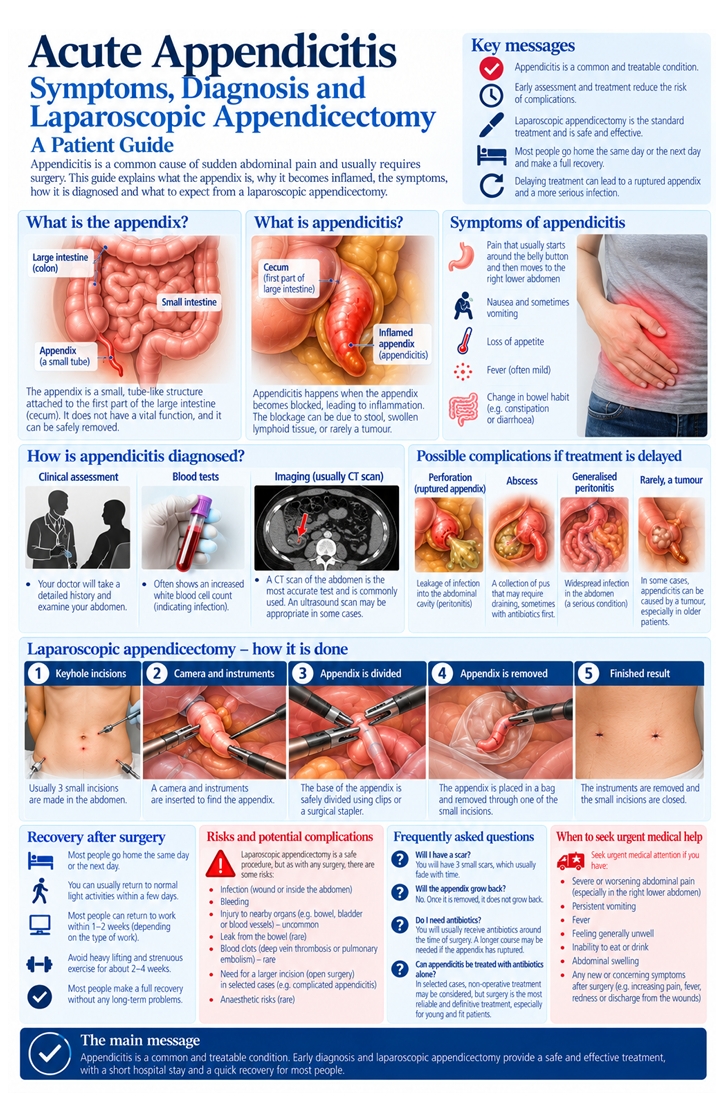
Acute appendicitis is one of the commonest causes of emergency abdominal surgery. It occurs when the appendix
becomes inflamed, usually after its lumen becomes obstructed. Although it can occur at almost any age, the
symptoms and severity vary considerably between patients.
The important principle is early assessment. Untreated appendicitis can progress from local inflammation to
perforation, abscess or widespread infection within the abdomen. When surgery is indicated, I generally perform a
laparoscopic appendicectomy using small keyhole incisions.
What is the appendix?
The appendix is a narrow blind-ending tube attached to the caecum, the first part of the large bowel. It has
immune-related tissue but is not essential for normal digestion, and people live normally after it is removed.
What causes appendicitis?
In many patients the appendix becomes obstructed by swelling of lymphoid tissue or a small piece of hard stool
called a faecolith. Pressure rises within the appendix, inflammation develops and bacterial infection can follow. In a
minority of patients, particularly older adults, another underlying lesion may be present.
What does appendicitis feel like?
Classically, discomfort begins around the umbilicus and later moves to the right lower abdomen. The pain often
becomes progressively more localised and is commonly accompanied by loss of appetite, nausea and sometimes
vomiting or fever.
Not every patient has classic symptoms
Children, older patients, pregnant patients and people with an unusually positioned appendix may present
differently. Diarrhoea, urinary symptoms or more generalised abdominal pain can sometimes occur.
How is appendicitis diagnosed?
Diagnosis begins with the history and abdominal examination. Blood tests can show inflammation, but no single
blood result proves or excludes appendicitis. Urine testing and, where relevant, pregnancy testing can help exclude
alternative diagnoses.
The role of imaging
CT is highly accurate in adults and can identify an inflamed appendix, perforation, abscess or an alternative cause of
pain. Ultrasound is useful in selected patients, particularly children and pregnancy. Imaging is chosen according to
age, clinical findings and the individual situation.
Why early treatment matters
As inflammation progresses, the wall of the appendix can become ischaemic and perforate. Infection may then
remain localised as an abscess or spread throughout the abdominal cavity as peritonitis.
Can appendicitis be treated with antibiotics alone?
Selected patients with uncomplicated appendicitis may be managed non-operatively with antibiotics, but recurrence
can occur and not every patient is suitable. Surgery remains a reliable definitive treatment, particularly in young and
fit patients and when complicated disease is suspected.
What is laparoscopic appendicectomy?
The operation is performed under general anaesthesia. Small incisions allow a camera and laparoscopic
instruments to enter the abdomen. The appendix is identified, its blood supply is controlled and its base is divided
before the appendix is removed in a retrieval bag.
Why use the laparoscopic approach?
Laparoscopy allows the entire abdomen to be inspected through small incisions. It is associated with small scars,
early mobilisation and generally rapid recovery, and it can also help identify another diagnosis when the cause of
pain was uncertain.
What if the appendix has already perforated?
Perforation does not necessarily prevent laparoscopic surgery. Contamination is dealt with, the appendix is removed
when appropriate and antibiotics are given. The operation and recovery can be more complex than for
uncomplicated appendicitis.
What if there is an appendiceal abscess?
A well-formed abscess or inflammatory mass may sometimes be treated initially with antibiotics, with image-guided
drainage when appropriate. Immediate surgery is not always the best option, and treatment is individualised
according to the patient's condition and imaging.
What happens to the appendix after removal?
The appendix is sent for histopathological examination. Most specimens simply confirm acute appendicitis, but
pathology can occasionally identify an unexpected tumour or another condition.
Do I need antibiotics?
Antibiotics are routinely given around the time of surgery. For uncomplicated appendicitis, prolonged postoperative
antibiotics are usually unnecessary. Complicated or perforated appendicitis may require a longer course according
to operative findings and clinical progress.
What are the risks of appendicectomy?
Potential complications include bleeding, wound infection, intra-abdominal abscess, injury to nearby bowel or other
structures, blood clots and anaesthetic complications. Conversion to an open operation is occasionally necessary.
Recovery after surgery
After uncomplicated laparoscopic appendicectomy, many patients can leave hospital the same day or the following
day. Fluids and food are resumed as tolerated, and walking begins early.
Pain and wound care
Some soreness around the small incisions is expected and usually improves steadily. Increasing redness, swelling,
discharge, fever or pain that is becoming worse rather than better should be reported.
Returning to normal activity
Light daily activity and walking are encouraged early. Return to work depends on the patient's recovery and job
demands. Heavy lifting and strenuous exercise are generally delayed until healing is satisfactory and according to
individual surgical advice.
When should I seek urgent help after surgery?
Persistent fever, worsening abdominal pain, repeated vomiting, increasing abdominal swelling, inability to eat or
drink, wound discharge, breathlessness or feeling progressively unwell require medical assessment.
Can the appendix grow back?
No. Once the appendix has been removed, it does not grow back. Rare inflammation of a residual appendiceal
stump can occur, but this is uncommon.
What is an appendiceal tumour?
Tumours of the appendix are uncommon and are sometimes discovered unexpectedly on pathology. If one is found,
the next steps depend on its type, size, location and pathological features and may require further investigation or
surgery.
My approach to suspected appendicitis
I assess the clinical history and examination together with blood tests and appropriate imaging rather than
relying on a single finding. When appendicectomy is indicated, I generally use a laparoscopic approach.
During surgery I inspect the abdomen, control the appendiceal blood supply, securely divide the appendix
at its base and remove it in a retrieval bag. The specimen is sent for histopathology. Antibiotic duration and
postoperative care are then tailored to whether the appendicitis was uncomplicated or perforated.
Frequently Asked Questions
Is every right-sided abdominal pain appendicitis?
No. Gallbladder, bowel, urinary and gynaecological conditions can produce similar symptoms, which is why proper
assessment is important.
Can I have appendicitis without fever?
Yes. Fever may be absent, especially early in the illness.
Does a normal blood test rule it out?
No. Blood tests support the diagnosis but cannot reliably exclude appendicitis by themselves.
Will I have a large scar?
Most laparoscopic appendicectomies use a few small incisions. An open incision is occasionally required.
How long does the operation take?
Operating time varies according to anatomy and whether the appendix is uncomplicated, perforated or surrounded
by adhesions or infection.
Will I need a drain?
Not routinely. A drain is used selectively rather than automatically.
Can I live normally without my appendix?
Yes.
What if pathology finds something unexpected?
The result is reviewed and any additional investigation or treatment is planned according to the specific diagnosis.
Can appendicitis come back after antibiotics?
Yes. Recurrence is one of the considerations when uncomplicated appendicitis is treated non-operatively.
Is perforated appendicitis dangerous?
It can cause abscess, peritonitis and sepsis, so prompt medical and surgical assessment is important.
The key message
Appendicitis is common and treatable, but delay can allow inflammation to progress to perforation and
infection. Diagnosis combines clinical assessment with laboratory tests and imaging when appropriate. For
patients who need surgery, laparoscopic appendicectomy provides definitive treatment with small incisions
and usually a relatively quick recovery.
Patient-information note: abdominal pain can have many causes. Severe or worsening abdominal pain, persistent vomiting, fever or feeling acutely unwell requires medical assessment rather than self-diagnosis.
Dr. Mohammed Alassaf
Consultant Bariatric & Gastrointestinal Surgeon
Dr. Alassaf is a leading expert in minimally invasive and bariatric surgery,
with extensive experience helping patients overcome obesity and related conditions.
Having completed advanced training in Australia and the Middle East, he is known
for his compassionate approach and evidence-based surgical care.