Finding a thyroid nodule is very common and understandably raises concern about cancer. The reassuring fact is that
most thyroid nodules are benign and most do not need an operation. The purpose of assessment is to identify the
smaller group that needs biopsy, treatment or surgery while allowing low-risk nodules to be followed safely.
What is a thyroid nodule?
A thyroid nodule is a discrete lump within the thyroid gland. It may be solid, cystic or a mixture of both. Some nodules
are discovered because a patient notices a neck lump, while many are found incidentally during ultrasound, CT or other
imaging performed for an unrelated reason.
Does a thyroid nodule mean cancer?
No. Most thyroid nodules are benign. The challenge is not to operate on every nodule, but to identify features that make
malignancy more or less likely. Ultrasound appearance, nodule size, thyroid function, clinical history and - when
indicated - fine-needle aspiration (FNA) are considered together.
How is a thyroid nodule evaluated?
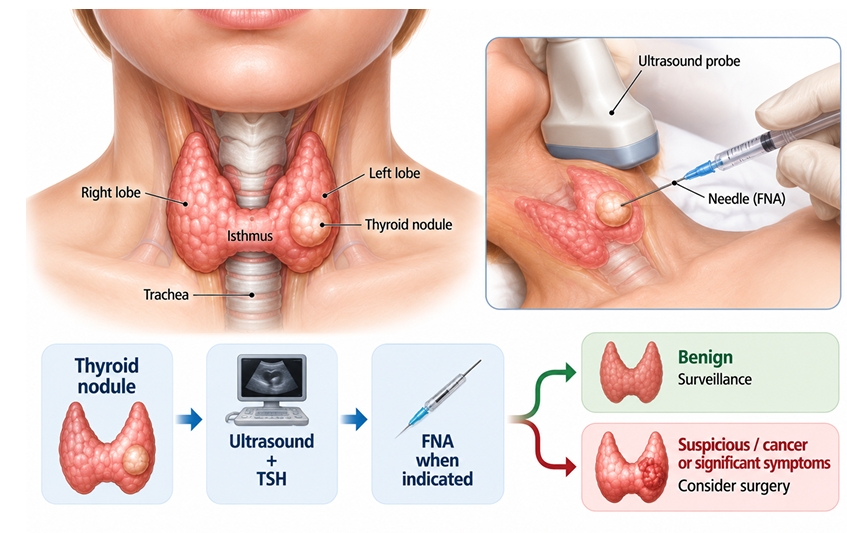
Assessment usually begins with a clinical examination, a blood test for thyroid-stimulating hormone (TSH), and a
dedicated thyroid and neck ultrasound. Ultrasound confirms the size and composition of the nodule and looks for
features associated with a higher risk of malignancy. It also examines lymph nodes in the neck.
What does the ultrasound tell us?
Ultrasound is much more useful than size alone. The radiologist or clinician evaluates whether the nodule is solid or
cystic, its echogenicity, margins, shape and calcifications, as well as any suspicious lymph nodes. Risk-classification
systems use these features to help decide whether FNA is appropriate.
Does every nodule need a needle biopsy?
No. Very small or clearly low-risk nodules often do not require FNA. Biopsy thresholds depend on the ultrasound risk
pattern and nodule size. Avoiding unnecessary biopsy is important because many small thyroid abnormalities will never
cause harm.
What is an FNA?
Fine-needle aspiration is a simple procedure in which a very thin needle is guided into the nodule, usually under
ultrasound, to collect cells for examination by a pathologist. Several samples may be taken. It is generally an outpatient
procedure and usually takes less than 30 minutes.
What can the biopsy result show?
Cytology is commonly reported using the Bethesda system. A result may be benign, malignant, suspicious for
malignancy, indeterminate, or occasionally non-diagnostic. A benign result usually leads to surveillance. Malignant or
strongly suspicious results usually lead to a surgical discussion. Indeterminate results require a more individualised
decision.
What happens if the biopsy is indeterminate?
An indeterminate result does not mean that cancer is present. Depending on the Bethesda category, ultrasound
findings, nodule size, patient preference and local availability, options can include repeat FNA, molecular testing,
surveillance or diagnostic surgery - commonly removal of the affected thyroid lobe.
When is surgery recommended for a thyroid nodule?
Surgery is most clearly considered when cytology shows cancer or is strongly suspicious for cancer. It may also be
appropriate for selected indeterminate nodules, nodules causing pressure or swallowing/breathing symptoms,
significant goitre, or hyperfunctioning disease when surgery is the preferred treatment.
Can a benign nodule still need surgery?
Yes. A benign nodule can become large enough to cause pressure, difficulty swallowing, airway symptoms or a visible
neck swelling that significantly troubles the patient. Continued growth or development of new suspicious ultrasound
features can also prompt reassessment. The decision should balance symptoms and risk against the consequences of
surgery.
What about a 'hot' or toxic thyroid nodule?
If TSH is low, further assessment may show that a nodule is autonomously producing thyroid hormone. These nodules
are approached differently from ordinary non-functioning nodules. Treatment options can include radioactive iodine,
surgery or other selected therapies depending on the patient and the nodule.
Can benign nodules be treated without surgery?
Yes. Observation is appropriate for many. For selected symptomatic benign nodules, image-guided ablation techniques
such as radiofrequency ablation may offer an alternative to surgery in experienced centres. Suitability depends on
confident benign diagnosis, nodule characteristics, local expertise and patient preference.
If surgery is needed, is the whole thyroid removed?
Not necessarily. For a nodule confined to one lobe, a thyroid lobectomy may be sufficient for many benign conditions,
diagnostic operations and selected cancers. Total thyroidectomy is used when disease involves both lobes or when
the diagnosis and treatment plan require removal of the entire gland.
What is a thyroid lobectomy?
A lobectomy removes one thyroid lobe, usually together with the isthmus. The remaining lobe may produce enough
thyroid hormone to avoid lifelong replacement, although some patients will still require thyroid hormone tablets.
What is total thyroidectomy?
Total thyroidectomy removes essentially the entire thyroid gland. Lifelong thyroid hormone replacement is then
required. Because both sides of the neck are operated on, calcium and recurrent laryngeal nerve considerations are
particularly important.
What are the important risks of thyroid surgery?
Important risks include bleeding in the neck, infection, voice change from recurrent laryngeal nerve injury and,
particularly after total thyroidectomy, low calcium due to temporary or permanent parathyroid dysfunction. Serious
complications are uncommon in experienced hands but should be discussed before surgery.
What should I expect after surgery?
Many patients mobilise and eat normally soon after surgery. There is usually some neck tightness or discomfort for
several days. Depending on the extent of surgery and local practice, patients may go home the same day or after
observation. Pathology then determines whether any further treatment or surveillance is required.
What happens if the nodule is benign and we do not operate?
Surveillance is based mainly on ultrasound and clinical review. Follow-up intervals depend on the original ultrasound
pattern, biopsy result and subsequent change. Growth does not automatically mean cancer, but meaningful growth or
new suspicious features can lead to repeat evaluation.
The goal is not to remove every thyroid nodule. It is to identify the nodules that genuinely benefit from
intervention while avoiding unnecessary thyroid surgery in patients who can be followed safely.
Frequently Asked Questions
My nodule is large. Does that mean it is cancer?
No. Size alone does not diagnose cancer. Ultrasound characteristics, cytology and the clinical picture are more
informative.
My biopsy is benign. Can I forget about the nodule?
Usually it still requires appropriate follow-up, although the intensity depends on its ultrasound features and clinical
course.
Does an indeterminate biopsy mean I need total thyroidectomy?
No. Repeat sampling, molecular testing, surveillance or diagnostic lobectomy may be appropriate depending on the
individual case.
Will I need thyroid tablets after lobectomy?
Not everyone does. The remaining lobe may provide sufficient hormone, but thyroid function is checked after surgery.
Will I need thyroid tablets after total thyroidectomy?
Yes. Thyroid hormone replacement is required for life after total thyroidectomy.
Can a thyroid nodule be treated without an operation?
Yes. Many are simply monitored. Selected benign symptomatic nodules may also be candidates for image-guided
ablation in experienced centres.
The key message
Most thyroid nodules do not need surgery. A good decision begins with thyroid function testing and a
high-quality ultrasound, followed by FNA only when indicated. Surgery is reserved for nodules in which cancer
risk, symptoms, function or other clinical factors make intervention more beneficial than continued
surveillance.
This article is for general patient education and does not replace individual assessment by your endocrinologist, radiologist or surgeon.
Dr. Mohammed Alassaf
Consultant Bariatric & Gastrointestinal Surgeon
Dr. Alassaf is a leading expert in minimally invasive and bariatric surgery,
with extensive experience helping patients overcome obesity and related conditions.
Having completed advanced training in Australia and the Middle East, he is known
for his compassionate approach and evidence-based surgical care.