Rectus Diastasis or Hernia? How Can You Tell the Difference?
Rectus Diastasis & Abdominal Wall Hernias
Rectus Diastasis or Hernia? How Can You Tell the Difference?
Dr-Alassaf
Nov 05, 2026
A bulge in the middle of the abdomen does not always mean that you have a hernia. Two common conditions - rectus diastasis and a midline abdominal-wall hernia - can look similar, but they are not the same problem.
The distinction matters because their risks and treatment are different. They can also occur together, and when they do, simply repairing the small hernia may not address the wider weakness of the abdominal wall.
What is rectus diastasis?
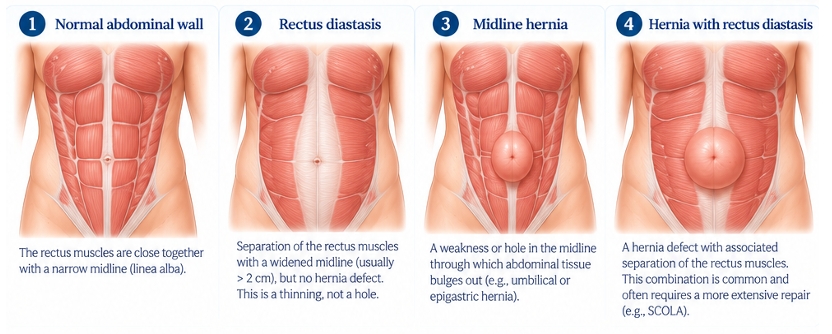
The rectus muscles are the two long muscles running vertically down the front of the abdomen. Normally they sit relatively close together, joined in the middle by a strong band of connective tissue called the linea alba.
In rectus diastasis, this central tissue becomes stretched and widened, allowing the two rectus muscles to move farther apart. The result may be a long ridge or bulge along the centre of the abdomen, particularly when sitting up, coughing or tightening the abdominal muscles.
Rectus diastasis is not a true hernia. There is no actual hole through the abdominal wall and therefore no hernia sac through which bowel can become trapped.
What is a hernia?
A hernia is different. It is a true defect or opening in the abdominal wall. Fat, bowel or other tissue can push through this opening and form a more localized lump.
Common midline examples include umbilical hernias around the belly button and epigastric hernias higher in the midline. An incisional hernia can also develop through the scar of a previous operation.
Why do they sometimes occur together?
Both conditions can reflect stretching or weakness of the abdominal midline. Pregnancy, changes in weight, ageing and repeated increases in abdominal pressure can contribute to widening of the linea alba.
A patient may therefore develop a small umbilical or epigastric hernia within an abdomen that also has significant rectus diastasis.
This combination is important because the visible hernia may be only one part of the abdominal-wall problem.
How can I tell which one I have?
Rectus diastasis often produces a broad, elongated ridge along the centre of the abdomen when the muscles are tightened. A hernia is more often a focal lump arising from a specific defect.
However, appearance alone is not always enough. A clinical examination is usually the most important first step. Ultrasound or CT imaging can be useful when the anatomy is unclear, when a previous operation has been performed, or when a hernia and diastasis are suspected together.
Is rectus diastasis dangerous?
Rectus diastasis itself does not carry the same risk of bowel incarceration or strangulation as a true hernia because there is no discrete hole through which bowel can become trapped.
It can nevertheless be bothersome. Some patients dislike the central bulge or feel that the abdominal wall has lost support. Others may have weakness or functional symptoms, although not every patient with diastasis has symptoms.
Does rectus diastasis need surgery?
Not necessarily. Many patients do not require an operation. Core-strengthening and physiotherapy can improve abdominal function, particularly when symptoms are mild.
Exercise can strengthen the abdominal muscles, but it may not completely close a significant separation of the rectus muscles. Surgery is considered selectively when the diastasis is substantial and symptomatic, when appearance is a major concern, or when a hernia is present at the same time.
When does a hernia need surgery?
A true hernia is assessed differently. Surgery may be recommended when it causes pain or discomfort, enlarges, interferes with activity, or has features that increase concern about trapping of its contents.
The operation depends on the size and location of the defect and on whether the surrounding abdominal wall is otherwise normal or has significant rectus diastasis.
What if I have both a hernia and rectus diastasis?
This is where treatment becomes more individualized. If a small midline hernia sits within a much wider area of rectus diastasis, repairing only the small hole may leave the surrounding midline weakness unchanged.
In selected patients, it may therefore make sense to repair the hernia and reconstruct the widened midline together. The rectus muscles are brought toward the centre by plicating the linea alba, while the hernia defect is repaired and the reconstruction may be reinforced with mesh when appropriate.
Where does SCOLA fit in?
SCOLA - Subcutaneous OnLay Laparoscopic Approach - is one minimally invasive technique that can be used in selected patients who have a small or moderate midline hernia together with significant rectus diastasis.
The operation is performed in a plane underneath the skin and fatty tissue but above the abdominal-wall fascia. The hernia is closed, the rectus diastasis is plicated over a longer segment, and an onlay mesh may be used to reinforce the reconstructed abdominal wall.
SCOLA is a specialized technique and is not widely used in Jordan. It is not appropriate for every patient with diastasis or every ventral hernia, so careful patient selection is important.
Is surgery for rectus diastasis cosmetic?
Not always. Some patients seek treatment mainly because of appearance, while others have a hernia or functional abdominal-wall problem as well.
When a hernia and significant diastasis coexist, the objective can be to reconstruct the abdominal wall as a whole rather than simply improve appearance. This is different from an abdominoplasty, which primarily addresses excess skin and contour and may involve different operative goals.
Frequently Asked Questions
Can rectus diastasis turn into a hernia?
Rectus diastasis and hernia are different conditions. Diastasis does not simply become a hernia, although the two can develop in the same patient and may occur in the same part of the abdominal wall.
Can bowel become trapped in rectus diastasis?
Not in the diastasis itself, because there is no true hernia defect. If a separate hernia is also present, that hernia can potentially trap its contents.
Do I need a CT scan?
Not always. Many cases can be diagnosed clinically. Imaging is useful when the diagnosis or anatomy is uncertain, when the abdominal wall is complex, or when planning surgery.
Can exercise close rectus diastasis?
Exercise can improve core strength and abdominal function, but a significant anatomical separation may remain. The value of physiotherapy and the need for surgery depend on symptoms, anatomy and the patient's goals.
If I have a small umbilical hernia and diastasis, should both be repaired?
Not automatically. The decision depends on the size of the hernia, the degree of diastasis, symptoms, tissue quality and the overall abdominal-wall anatomy. In selected patients, treating both together can provide a more complete reconstruction.
Is SCOLA the same as a tummy tuck?
No. SCOLA is an abdominal-wall repair aimed at correcting a hernia and rectus diastasis through a minimally invasive subcutaneous approach. It does not remove large amounts of excess skin in the way an abdominoplasty does.
The key message
Rectus diastasis and a hernia can look similar, but they are not the same condition.
Rectus diastasis is a widening and thinning of the abdominal midline without a true hole. A hernia is a true defect in the abdominal wall through which tissue can protrude.
When both occur together, treatment should consider the whole abdominal wall, not just the small visible hernia. In carefully selected patients, techniques such as SCOLA can repair the hernia and reconstruct the associated rectus diastasis during the same operation.
Dr. Mohammed Alassaf
Consultant Bariatric & Gastrointestinal Surgeon
Dr. Alassaf is a leading expert in minimally invasive and bariatric surgery,
with extensive experience helping patients overcome obesity and related conditions.
Having completed advanced training in Australia and the Middle East, he is known
for his compassionate approach and evidence-based surgical care.