Left and Sigmoid Colectomy: What Patients Need to Know
Colon Cancer & Colorectal Surgery
Left and Sigmoid Colectomy: What Patients Need to Know
Dr-Alassaf
Nov 02, 2026
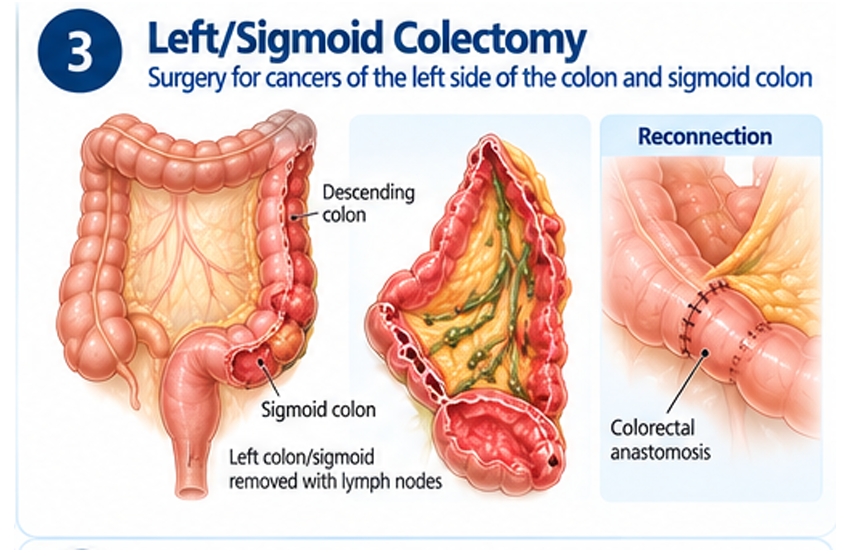
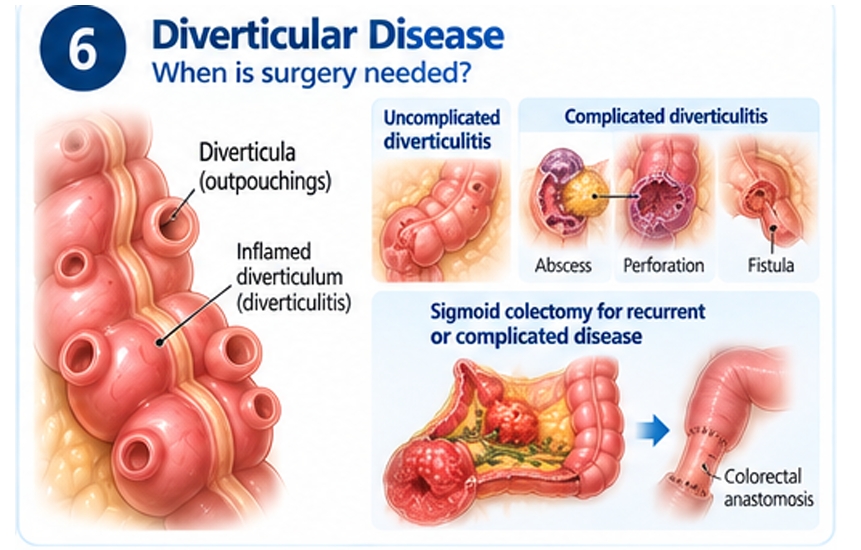
Left-sided and sigmoid colectomy remove the diseased portion of the descending or sigmoid colon. They are performed most often for colorectal cancer or complicated diverticular disease. The operation is planned around the exact disease location, its blood supply and the amount of healthy bowel needed for a safe reconstruction.
What part of the bowel is removed?
A sigmoid colectomy removes the sigmoid colon, while a left hemicolectomy removes a larger portion of the descending and sometimes transverse colon. For cancer, the associated mesentery, feeding vessels and regional lymph nodes are removed as part of the oncological specimen.
How is the bowel reconnected?
The remaining colon is usually joined to the upper rectum or distal colon, creating a colorectal or colocolic anastomosis. The surgeon ensures that the bowel reaches without tension and has good blood supply before creating the join.
Can this be done laparoscopically?
Yes. Many elective left and sigmoid resections can be performed laparoscopically. The operation still follows the same internal oncological or disease-specific principles as open surgery. Conversion to open surgery is sometimes the safest option.
Why is the splenic flexure sometimes mobilised?
The colon near the spleen may need to be freed so that the remaining bowel reaches the rectum without tension. This is called splenic-flexure mobilisation. It is performed selectively according to the planned resection and anatomy.
Will I need a stoma?
Most elective left-sided colon operations can be reconstructed without a stoma. Diversion becomes more likely with a very low anastomosis, emergency surgery, severe contamination, poor tissue quality or when the patient's condition makes a bowel join unsafe.
What is an anastomotic leak?
A leak means that the new bowel join has not sealed completely. It can cause fever, abdominal pain, infection or sepsis and may require antibiotics, drainage or further surgery. Risk varies with the level of the anastomosis and patient factors.
How will bowel habits change?
Frequency and urgency can increase temporarily after sigmoid or left colectomy. Most patients adapt over weeks to months. Long-term function depends partly on how much colon and rectum have been removed.
What happens after cancer surgery?
The pathology report describes tumour depth, lymph nodes and resection margins. These findings establish the final stage and determine whether postoperative chemotherapy should be considered.
Frequently Asked Questions
Is sigmoid colectomy the same operation for cancer and diverticulitis?
The bowel segment may overlap, but cancer surgery requires formal oncological lymphatic clearance, while diverticular surgery is planned around diseased bowel and a healthy rectal endpoint.
Can I eat normally afterwards?
Usually yes, with gradual progression during recovery.
Will the operation affect continence?
A standard sigmoid or left colectomy usually preserves the rectum and sphincters, so major continence problems are uncommon.
The key message
The objective is to remove the correct diseased left-colon segment, preserve healthy bowel and create a well-perfused, tension-free anastomosis whenever safe.
This article is for general patient education and does not replace individual assessment, cancer staging, multidisciplinary review or advice from your treating surgical team.
Dr. Mohammed Alassaf
Consultant Bariatric & Gastrointestinal Surgeon
Dr. Alassaf is a leading expert in minimally invasive and bariatric surgery,
with extensive experience helping patients overcome obesity and related conditions.
Having completed advanced training in Australia and the Middle East, he is known
for his compassionate approach and evidence-based surgical care.