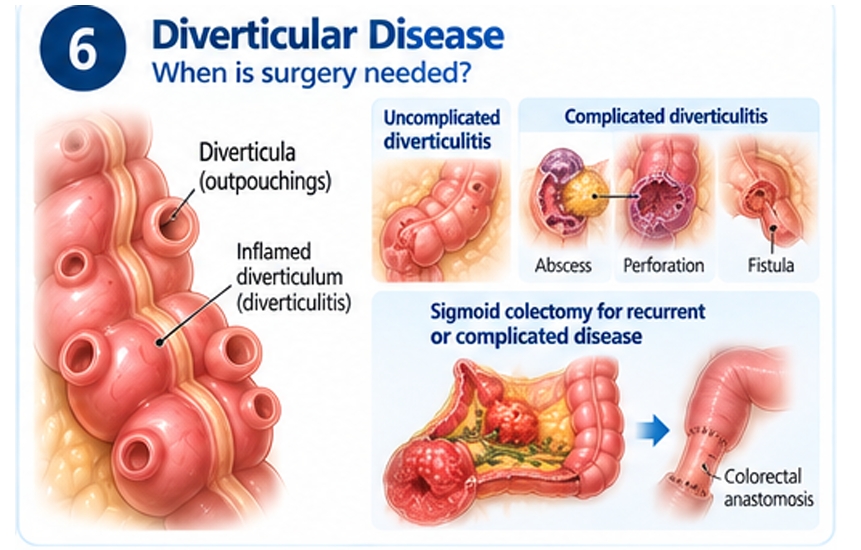
Diverticula are small pouches that form in the wall of the colon, most commonly the sigmoid colon. Many people never develop symptoms. Surgery is not based simply on the number of attacks; it is considered when complications, recurrent severe episodes or persistent symptoms make the expected benefit greater than the risks of an operation.
What is diverticulitis?
Diverticulitis occurs when a diverticulum becomes inflamed and sometimes perforates microscopically. Symptoms commonly include left lower abdominal pain, fever and altered bowel habit. CT is frequently used when the diagnosis or severity is uncertain.
What is uncomplicated diverticulitis?
Uncomplicated disease means inflammation without abscess, free perforation, fistula or obstruction. Many stable patients can be managed without surgery. Antibiotics are used selectively rather than automatically in every mild uncomplicated case.
What makes diverticulitis complicated?
Complications include an abscess, fistula to another organ, narrowing or obstruction, or free perforation with peritonitis. These problems change management and make surgery more likely.
How is a diverticular abscess treated?
Antibiotics are used, and larger or accessible collections may be drained through the skin under radiological guidance. Emergency surgery is needed if sepsis cannot be controlled or the patient deteriorates.
When is emergency surgery necessary?
Free perforation with generalised peritonitis, uncontrolled sepsis, bowel obstruction or failure of non-operative treatment can require urgent surgery.
When should elective surgery be considered?
The decision is individual. Recurrent severe attacks, persistent symptoms affecting quality of life, strictures, fistulas and previous complicated disease can all support elective sigmoid colectomy. Age and attack count alone are not enough.
What operation is performed?
Elective surgery usually removes the diseased sigmoid colon and joins healthy descending colon to the upper rectum. The distal endpoint should be healthy rectum rather than residual diseased sigmoid.
Will I need a stoma?
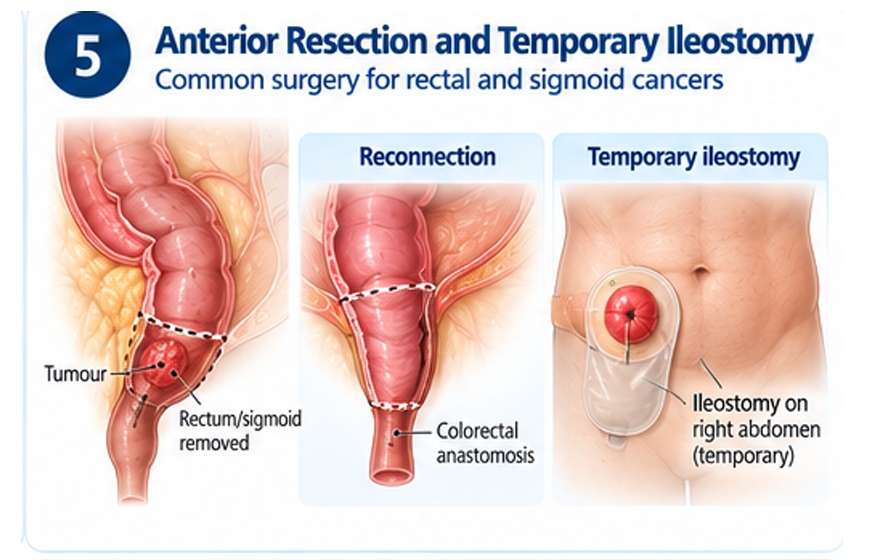
A stoma is uncommon in straightforward elective surgery. It is more likely in emergency surgery with severe contamination or when a safe anastomosis cannot be created.
What is a Hartmann procedure?
In selected emergencies, the diseased sigmoid is removed, the rectal stump is closed and the colon is brought out as an end colostomy. Reversal may be possible later, but is not guaranteed.
Can diverticulitis recur after sigmoid colectomy?
Recurrence is much less common after appropriate resection but is not impossible because diverticula may remain elsewhere in the colon.
Frequently Asked Questions
Do two attacks mean I need surgery?
No. Current practice is individualised around severity, complications, quality of life and operative risk.
Do I need colonoscopy after diverticulitis?
Colonic evaluation is often advised after complicated or atypical disease and when recent high-quality colon evaluation is lacking.
Can surgery be laparoscopic?
Yes. Elective sigmoid colectomy is commonly suitable for laparoscopy when expertise is available.
The key message
Diverticular surgery is not triggered by a fixed number of attacks. The decision is based on complications, severity, persistent symptoms, quality of life and the risks and benefits for the individual patient.
This article is for general patient education and does not replace individual assessment, cancer staging, multidisciplinary review or advice from your treating surgical team.
Dr. Mohammed Alassaf
Consultant Bariatric & Gastrointestinal Surgeon
Dr. Alassaf is a leading expert in minimally invasive and bariatric surgery,
with extensive experience helping patients overcome obesity and related conditions.
Having completed advanced training in Australia and the Middle East, he is known
for his compassionate approach and evidence-based surgical care.