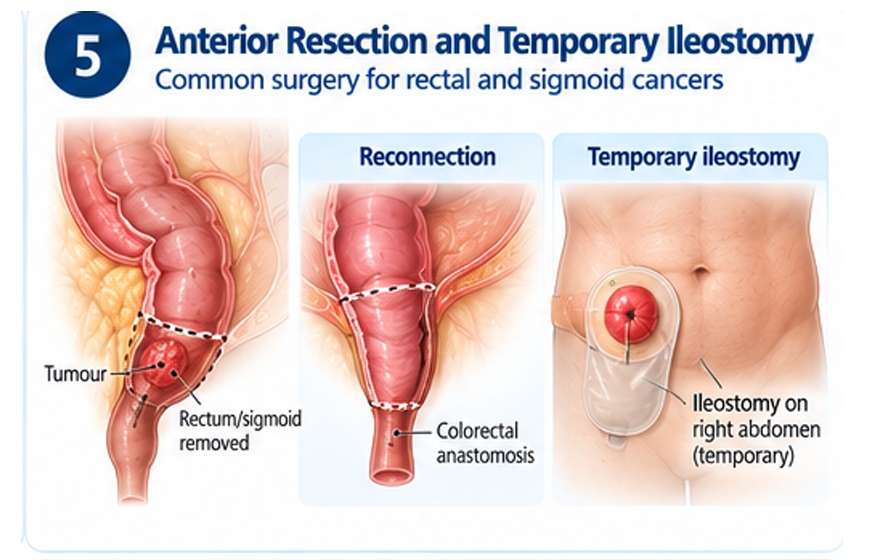
An anterior resection removes part or all of the rectum while preserving the anus and sphincter. It is commonly used for rectal and rectosigmoid cancer. When the new bowel join is very low in the pelvis, a temporary loop ileostomy may be created to protect the consequences of a leak while healing occurs.
What is removed during an anterior resection?
The exact operation depends on tumour level. The diseased rectum and its mesorectum are removed with appropriate cancer margins and lymphatic tissue. The remaining colon is then brought down into the pelvis for reconstruction.
How is the bowel reconnected?
The colon is joined to the remaining rectum or, for very low tumours, close to the anal canal. This colorectal or coloanal anastomosis is commonly created with a circular stapling device, although technique varies.
Why might I need a temporary ileostomy?
A loop ileostomy diverts bowel contents away from the low pelvic join. It does not prevent every anastomotic leak, but it can reduce the severity of a leak and the need for major emergency reoperation.
Who is more likely to need diversion?
Diversion is considered when the anastomosis is very low, after preoperative radiotherapy, when healing risk is increased or when the surgeon has concerns about the reconstruction. The decision is individual.
What is living with an ileostomy like?
An ileostomy usually sits on the right side of the abdomen and produces liquid to semi-formed output. Patients receive specialist stoma education about appliances, skin care, diet, fluid intake and recognising dehydration.
When can the ileostomy be reversed?
Reversal is considered once the anastomosis has healed and the patient is sufficiently recovered. Timing also depends on chemotherapy and overall cancer treatment. The bowel join may be assessed before reversal when clinically indicated.
Is reversal guaranteed?
No. Although the intention is temporary, some stomas are never reversed because of healing problems, cancer progression, poor function or other health issues.
What is low anterior resection syndrome?
After rectal resection, the bowel's storage capacity and pelvic function change. Symptoms can include frequency, urgency, clustering of bowel movements, fragmentation and difficulty distinguishing gas from stool.
Can bowel function improve?
Yes. Function often improves substantially over the first year or longer. Diet, medication, pelvic-floor rehabilitation and bowel-management strategies can help selected patients.
What are the major surgical risks?
Important risks include anastomotic leak, bleeding, infection, ileus, bowel obstruction, urinary or sexual dysfunction, stoma complications and general risks of major abdominal surgery.
Frequently Asked Questions
Does the ileostomy mean the cancer operation failed?
No. It is a protective surgical strategy used to make a low reconstruction safer.
How long is a temporary ileostomy usually present?
There is no single duration; it depends on healing and the rest of the cancer-treatment plan.
Will bowel function be exactly as before after reversal?
Not necessarily. Rectal resection can permanently alter bowel function, although adaptation is common.
The key message
Anterior resection aims to remove rectal cancer while preserving the anal sphincter. A temporary ileostomy is sometimes used as protection for a low pelvic anastomosis and is reversed only when healing and overall treatment make it safe.
This article is for general patient education and does not replace individual assessment, cancer staging, multidisciplinary review or advice from your treating surgical team.
Dr. Mohammed Alassaf
Consultant Bariatric & Gastrointestinal Surgeon
Dr. Alassaf is a leading expert in minimally invasive and bariatric surgery,
with extensive experience helping patients overcome obesity and related conditions.
Having completed advanced training in Australia and the Middle East, he is known
for his compassionate approach and evidence-based surgical care.