Graves’ Disease and Thyroidectomy: When Is Surgery the Right Choice?
Graves’ Disease & Thyroid Surgery
Graves’ Disease and Thyroidectomy: When Is Surgery the Right Choice?
Dr-Alassaf
Nov 03, 2026
Graves’ disease is an autoimmune condition that makes the entire thyroid overactive. Medication, radioactive iodine and
surgery are all established treatments. Thyroidectomy offers rapid, definitive control and is particularly useful in selected
patients where the characteristics of the disease make surgery attractive.
What is Graves’ disease?
The immune system produces antibodies that stimulate the thyroid, causing excess thyroid hormone. Symptoms can
include palpitations, tremor, heat intolerance, weight loss, anxiety and muscle weakness. Some patients also develop
thyroid eye disease.
What are the main treatment options?
Antithyroid medication, radioactive iodine and surgery can all control Graves’ hyperthyroidism. The best option depends
on age, goitre size, eye disease, pregnancy considerations, medication tolerance, disease control and patient
preference.
When is surgery particularly useful?
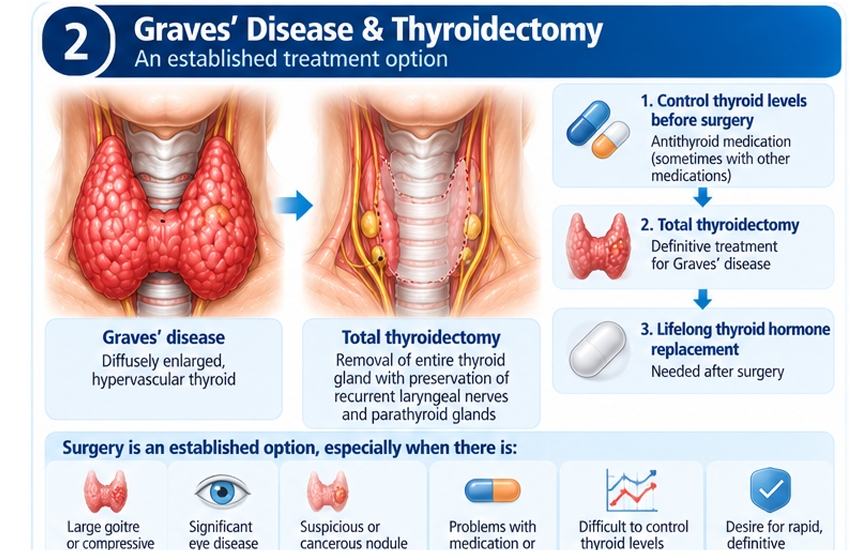
Surgery is an established option for a large goitre or compressive symptoms, significant eye disease, a suspicious
thyroid nodule or cancer, difficulty controlling hormone levels, serious medication side effects, or when rapid definitive
treatment is desired
What operation is performed?
For Graves’ disease, total or near-total thyroidectomy is the standard surgical approach. Leaving substantial thyroid
tissue risks recurrent hyperthyroidism. The recurrent laryngeal nerves and parathyroid glands are carefully preserved.
Why must thyroid levels be controlled first?
Operating during severe uncontrolled hyperthyroidism increases cardiovascular risk and can precipitate thyroid storm.
Antithyroid medication and beta-blockade are commonly used before surgery. Short-course iodine may also be
prescribed before thyroidectomy.
What about Graves’ eye disease?
Radioactive iodine can worsen thyroid eye disease in some patients, particularly smokers. Surgery avoids that
radiation-related exacerbation and is therefore an important definitive option when significant eye disease is present.
What are the main surgical risks?
The key risks are postoperative bleeding, temporary or permanent voice change from laryngeal nerve injury, and
temporary or permanent hypocalcaemia from parathyroid dysfunction. Graves’ glands are often more vascular than
normal thyroids.
What happens to my medications?
Antithyroid medication is generally stopped at surgery. Beta-blockers may be tapered according to heart rate and
symptoms. Levothyroxine replacement begins after thyroid removal, and calcium/vitamin D are used when indicated.
Will Graves’ disease be cured?
Thyroidectomy provides definitive control of thyroid overactivity because the hormone-producing gland is removed.
Thyroid antibodies and eye disease have a separate course and may not disappear immediately.
What is recovery like?
Most patients have a sore throat and lower energy for several days. Calcium is monitored and the patient begins lifelong
thyroid-hormone replacement. Follow-up focuses on dose adjustment and any eye disease.
Frequently Asked Questions
Will I need thyroid tablets for life?
Yes, after total thyroidectomy.
Does surgery remove Graves’ eye disease?
No. It definitively treats the thyroid overactivity, but eye disease may require separate treatment.
Is radioactive iodine always preferable to surgery?
No. Both are established definitive treatments; individual clinical circumstances and preferences determine the choice.
The key message
Thyroidectomy is an established definitive treatment for Graves’ disease. It is particularly valuable for large
goitre, compressive symptoms, significant eye disease, suspicious nodules, medication problems, difficult
hormone control or a desire for rapid definitive treatment.
This article is for general patient education and does not replace individual endocrine, imaging or surgical assessment.
Dr. Mohammed Alassaf
Consultant Bariatric & Gastrointestinal Surgeon
Dr. Alassaf is a leading expert in minimally invasive and bariatric surgery,
with extensive experience helping patients overcome obesity and related conditions.
Having completed advanced training in Australia and the Middle East, he is known
for his compassionate approach and evidence-based surgical care.