Strangulated Hernia: Why Emergency Surgery May Be Necessary
Hernias & Emergency Hernia Surgery
Strangulated Hernia: Why Emergency Surgery May Be Necessary
Dr-Alassaf
Nov 02, 2026
A hernia occurs when fat or an internal organ pushes through a weak area in the abdominal wall. Many hernias
are not immediately dangerous, but a hernia can become an emergency if bowel becomes trapped and its blood
supply is threatened. Recognising the warning signs early can prevent bowel injury and serious infection.
What is the difference between a reducible, incarcerated and strangulated hernia?
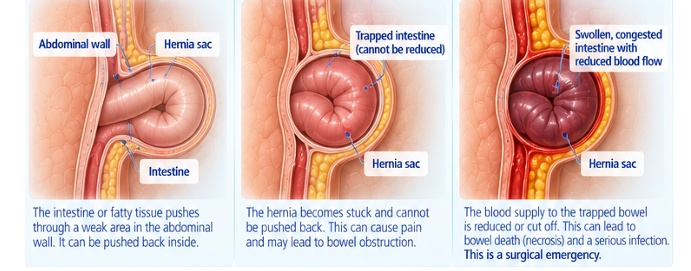
A reducible hernia can move back into the abdomen, either spontaneously or with gentle pressure. An
incarcerated (irreducible) hernia cannot be reduced; it may contain fat or bowel, and does not always have
impaired blood supply. A strangulated hernia occurs when the circulation to trapped contents is compromised.
If bowel is involved, this can progress to ischaemia, necrosis and perforation.
Which hernias can become strangulated?
Inguinal, femoral, umbilical, incisional and other abdominal-wall hernias can become trapped. Femoral hernias
deserve particular attention because they have a relatively high risk of incarceration and strangulation. The risk
in an individual patient depends on the type of hernia, its anatomy and symptoms.
What symptoms require urgent assessment?
Warning signs include a newly painful or increasingly tender lump that cannot be pushed back, sudden or
persistent severe pain, vomiting, abdominal swelling, inability to pass gas or stool, skin redness or discolouration
over the lump, fever, faintness or feeling seriously unwell. Not every patient has all these symptoms. Do not
forcefully push back a very painful or discoloured hernia.
How is a strangulated hernia diagnosed?
Diagnosis starts with urgent clinical examination and assessment of vital signs. Blood tests may assess
inflammation, kidney function, dehydration and possible tissue injury, but normal tests do not exclude
strangulation. CT is often useful when the diagnosis, hernia contents or bowel viability are uncertain; ultrasound
can be useful in selected circumstances. Imaging must not delay necessary emergency surgery when the
clinical picture is compelling.
Does every trapped hernia require immediate surgery?
An irreducible hernia needs prompt surgical assessment, but the urgency and approach depend on pain,
obstruction, signs of compromised blood flow and the patient’s condition. Selected patients without signs of
strangulation may be managed differently under surgical supervision. Suspected strangulation, peritonitis or
bowel ischaemia usually requires urgent operation.
What happens before emergency surgery?
The team will assess circulation and breathing, provide intravenous fluids and pain relief, and treat nausea.
Patients are kept fasting. A nasogastric tube may be needed if bowel obstruction causes substantial vomiting or
distension. Antibiotics are used when bowel compromise, contamination or other infection is suspected. The
anaesthetic and surgical teams explain the possible need for bowel resection.
How is the operation performed?
The surgeon releases the trapped contents, carefully assesses bowel viability and repairs the hernia defect.
Depending on the type of hernia, previous operations, distension and the patient’s condition, surgery may be
laparoscopic or open. The safest access takes priority over the size of the incision.
What if part of the bowel has lost its blood supply?
If bowel remains viable after release, it may be preserved. If a segment is irreversibly damaged, it must be
removed. The healthy ends can often be joined together (anastomosis), but in selected unstable or
contaminated cases a temporary stoma may be necessary. The decision depends on tissue condition and
overall safety.
Will mesh be used in an emergency repair?
Mesh can reduce recurrence in many hernia repairs, and may still be appropriate in selected emergency
operations. However, bowel resection, spillage, infection and the degree of contamination affect the choice. The
surgeon decides whether mesh, tissue repair or a staged strategy is safest for the specific situation.
What are the risks of emergency hernia surgery?
Possible risks include bleeding, wound or deep infection, injury to bowel or nearby structures, anastomotic leak if
bowel is resected, blood clots, pneumonia, recurrence and complications related to anaesthesia. Emergency
surgery, especially with ischaemic bowel or sepsis, generally carries greater risk than planned repair of an
uncomplicated hernia.
How long does recovery take?
Recovery varies considerably. If bowel is healthy and the repair is straightforward, eating, walking and discharge
may occur relatively quickly. Patients needing bowel resection or treatment for infection often stay longer. Return
to work and lifting restrictions depend on the operation and healing; patients should follow their own discharge
instructions.
Can strangulation be prevented?
Elective evaluation and timely repair of symptomatic or higher-risk hernias can reduce the chance of an
emergency. Not every asymptomatic hernia requires immediate surgery, but a new painful lump, increasing
difficulty reducing the hernia or repeated obstructive symptoms should prompt reassessment. The decision for
planned repair should be individualised.
Frequently asked questions
Can a strangulated hernia improve on its own? Suspected strangulation must be treated as an emergency;
delaying assessment risks bowel damage.
Can I eat or drink if I think my hernia is trapped? Seek emergency care and avoid eating or drinking until
assessed, as anaesthesia may be needed.
Does a normal CT exclude strangulation? No test is perfect; clinical findings remain crucial.
Will I definitely lose bowel? No. Early treatment may allow the bowel to be preserved.
Can the hernia recur? Yes, although the risk depends on the repair, tissues, infection and patient factors.
The key message
A hernia that becomes suddenly painful, irreducible or associated with vomiting or illness needs urgent
surgical assessment. Strangulation means the blood supply is at risk; prompt treatment can preserve
bowel and prevent life-threatening complications.
Dr. Mohammed Alassaf
Consultant Bariatric & Gastrointestinal Surgeon
Dr. Alassaf is a leading expert in minimally invasive and bariatric surgery,
with extensive experience helping patients overcome obesity and related conditions.
Having completed advanced training in Australia and the Middle East, he is known
for his compassionate approach and evidence-based surgical care.