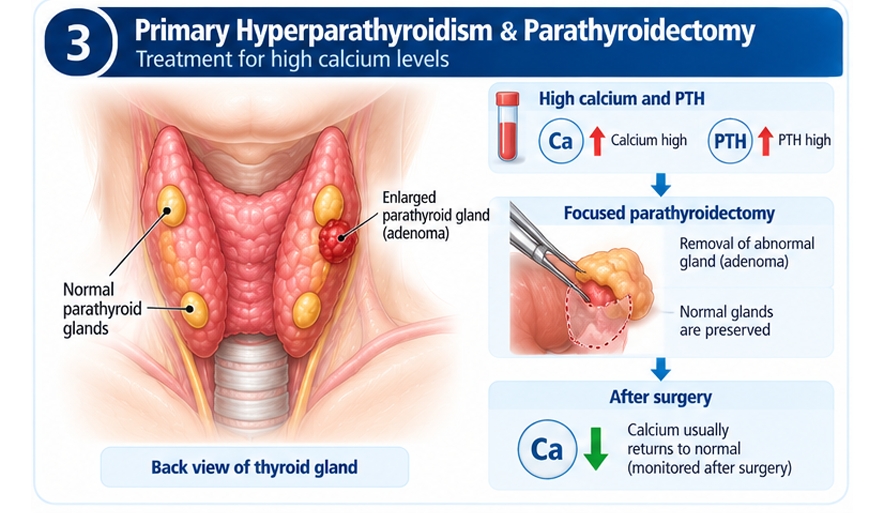
Primary hyperparathyroidism occurs when one or more parathyroid glands produce too much parathyroid hormone
(PTH), leading most characteristically to an elevated blood calcium. Surgery is the only definitive cure and can often be
performed through a focused neck approach when the abnormal gland has been localised.
What are the parathyroid glands?
Most people have four small parathyroid glands behind the thyroid. They regulate blood calcium through parathyroid
hormone. They are separate from the thyroid and have a completely different function.
What is primary hyperparathyroidism?
One or more glands become overactive and produce excessive PTH. In most patients a single benign adenoma is
responsible; some have enlargement of several glands. Parathyroid cancer is rare.
How is the diagnosis made?
Diagnosis is biochemical, not imaging-based. Repeated or confirmed elevated calcium together with an inappropriately
elevated or non-suppressed PTH supports the diagnosis. Kidney function, vitamin D, urinary calcium and other tests
may be needed to clarify the picture.
What symptoms can it cause?
Many patients are diagnosed before obvious symptoms develop. Hyperparathyroidism can contribute to kidney stones,
reduced bone density or fractures, kidney dysfunction and symptoms such as fatigue, thirst, frequent urination or
gastrointestinal complaints.
Who should have surgery?
Symptomatic patients are generally offered parathyroidectomy if fit for surgery. Surgery is also recommended in many
asymptomatic patients who meet guideline criteria based on calcium level, bone density/fracture, kidney involvement,
urinary calcium/stone risk or younger age.
Why do I need imaging if the blood tests already diagnose it?
Ultrasound, sestamibi scanning and sometimes 4D-CT are used to locate the abnormal gland before surgery. They do
not establish the diagnosis. Negative imaging does not exclude primary hyperparathyroidism.
What is focused parathyroidectomy?
When imaging convincingly identifies a single abnormal gland, a focused operation can remove that gland through a
small incision while preserving the normal glands. Some surgeons use intraoperative PTH testing to confirm an
adequate biochemical response.
When is bilateral neck exploration needed?
If imaging is discordant or negative, if multigland disease is suspected, or in certain inherited conditions, the surgeon
may inspect all four glands and remove the abnormal tissue according to the pattern found.
What happens to calcium after surgery?
Calcium usually falls toward normal after successful surgery. Some patients develop temporary low calcium as the
remaining glands recover or because calcium moves rapidly back into previously depleted bone.
What is hungry bone syndrome?
In patients with severe or longstanding disease, bones can avidly take up calcium after the excess PTH is removed.
This can cause significant hypocalcaemia requiring calcium and vitamin-D treatment and close monitoring.
What are the risks?
Risks include bleeding, infection, recurrent laryngeal nerve injury, persistent hyperparathyroidism if abnormal tissue
remains, recurrent disease and temporary or rarely prolonged hypocalcaemia.
What follow-up is needed?
Calcium is checked after surgery and again during follow-up. Bone density can improve after successful treatment, and
kidney-stone risk may decrease. Long-term biochemical review confirms durable cure.
Frequently Asked Questions
Can medication cure primary hyperparathyroidism?
Medication can manage selected consequences or lower calcium in some patients, but it does not provide the same
definitive cure as successful surgery.
If imaging is negative, does that mean I cannot have surgery?
No. Imaging localises disease; it does not diagnose it. An experienced parathyroid surgeon can perform bilateral
exploration when appropriate.
Will all four glands be removed?
Usually not. The aim is to remove abnormal hyperfunctioning tissue while preserving enough normally functioning
parathyroid tissue.
The key message
Primary hyperparathyroidism is diagnosed by biochemistry. Imaging is used to plan the operation, not to prove
the disease. When surgery is indicated, parathyroidectomy offers definitive treatment while preserving normal
parathyroid function.
This article is for general patient education and does not replace individual endocrine, imaging or surgical assessment.
Dr. Mohammed Alassaf
Consultant Bariatric & Gastrointestinal Surgeon
Dr. Alassaf is a leading expert in minimally invasive and bariatric surgery,
with extensive experience helping patients overcome obesity and related conditions.
Having completed advanced training in Australia and the Middle East, he is known
for his compassionate approach and evidence-based surgical care.