Hernia Mesh: Is It Safe? What Patients Need to Know
Hernia Mesh, Safety & Complications
Hernia Mesh: Is It Safe? What Patients Need to Know
Dr-Alassaf
Nov 04, 2026
Many patients become concerned when they hear that their hernia repair may involve mesh. This is understandable. Mesh has received considerable attention, and patients often arrive with questions about pain, infection, rejection or whether the mesh can move.
The important point is that hernia mesh is not one single product and it is not used in one single way. Different meshes are designed for different operations and different positions in the abdominal wall.
For most inguinal hernias, international guidelines recommend a mesh-based repair because it reduces the risk of recurrence without increasing chronic pain overall. Mesh is also commonly used to reinforce ventral and incisional hernia repairs.
Why use mesh at all?
A hernia develops because there is a weakness or defect in the abdominal wall. Simply closing that opening with stitches can place tension on tissues that may already be weak.
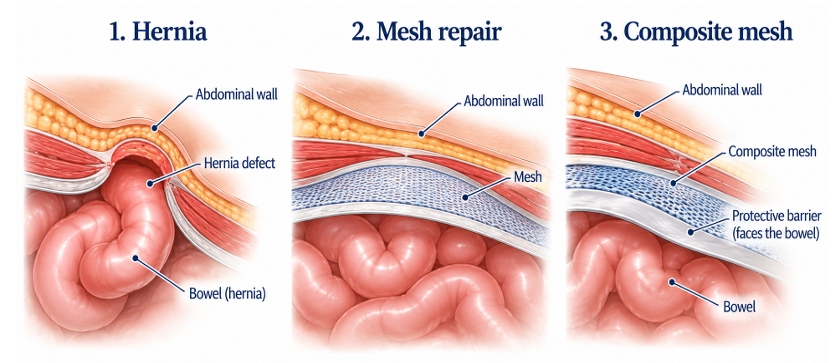
Mesh acts as a reinforcement. Instead of relying only on the edges of the defect, it spreads the forces of the repair over a wider area. The patient's own tissue then heals around and through the mesh.
This is why mesh-based repair has become an important part of modern hernia surgery.
Is mesh permanent?
Many commonly used hernia meshes are made from permanent synthetic materials such as polypropylene. Other meshes may contain partially absorbable components, and some specialized materials are designed to absorb over time.
The choice depends on the type of hernia, the position in which the mesh will be placed, the surgical technique and the individual patient.
Where is the mesh placed?
Mesh can be positioned in several different layers of the abdominal wall. In a laparoscopic TEP inguinal hernia repair, for example, the mesh is placed in the preperitoneal space, behind the muscles and in front of the lining of the abdominal cavity.
In some laparoscopic ventral or incisional hernia repairs, the mesh may be positioned inside the abdominal cavity. When I use this position, I use a composite mesh designed for intraperitoneal placement.
What is composite mesh?
When a mesh is placed inside the abdomen, one surface may lie close to the bowel. Composite mesh is designed specifically for this situation.
One side of a composite mesh is designed to integrate with the abdominal wall. The opposite, visceral-facing surface has a barrier intended to reduce direct tissue attachment to the bowel and other abdominal organs.
No material can guarantee that adhesions will never form, but the mesh is specifically engineered for the environment in which it is being used.
Can the body reject mesh?
Mesh is a foreign material, so the body naturally produces a healing and scar response around it. That reaction is part of how the mesh becomes incorporated into the abdominal wall.
This is different from organ-transplant rejection. True systemic allergic-type reactions to surgical mesh appear to be extremely uncommon.
Can mesh become infected?
Yes, but mesh infection is uncommon. The risk depends on the operation, the location of the mesh, wound problems, contamination, diabetes, smoking, obesity and other patient factors.
A superficial wound infection does not necessarily mean that the mesh itself is infected. A true deep mesh infection can be more difficult to treat and, in some cases, removal of the mesh may be necessary.
Can mesh cause chronic pain?
Persistent pain can occur after hernia surgery, particularly after inguinal hernia repair, but the cause is often more complicated than simply 'the mesh'.
Pain can arise from nerves, scar tissue, fixation, the original hernia, recurrence or the way tissues heal. Mesh characteristics and surgical technique can also contribute.
Importantly, current international groin-hernia guidelines conclude that mesh repair reduces recurrence compared with non-mesh repair without increasing chronic pain overall.
Can mesh shrink, move or erode?
These complications have been reported, but they are uncommon. Mesh can undergo some contraction as scar tissue forms around it. Rarely, migration or erosion into nearby structures can occur.
Correct mesh selection, adequate size and overlap, appropriate positioning and careful surgical technique are important in reducing these risks.
Does every hernia need mesh?
No. There are circumstances in which a non-mesh repair can be considered, particularly for selected inguinal hernias when an established tissue-repair technique and appropriate expertise are available.
However, for the majority of adult inguinal hernia repairs, current international guidance recommends a mesh-based technique. For midline incisional hernias, European Hernia Society guidance also recommends mesh-based repair.
Why are there different types of mesh?
A mesh used for an inguinal hernia in the preperitoneal space does not necessarily need the same properties as a mesh placed inside the abdominal cavity.
Meshes vary in material, pore size, weight, flexibility, coatings and whether parts of the material are absorbable. The important question is therefore not simply 'Is mesh being used?' but 'Which mesh is appropriate for this operation and where will it be placed?'
Frequently Asked Questions
Will I feel the mesh inside me?
Most patients do not continuously feel the mesh once healing is complete. Some patients experience temporary tightness or awareness of the repair during recovery, and a smaller number develop persistent discomfort.
Will the mesh set off airport security?
No. Standard hernia mesh does not normally trigger airport metal detectors.
Can I have an MRI after mesh repair?
Most commonly used hernia meshes are compatible with MRI. If fixation devices or another implant were used, the exact implant information can be checked when necessary.
Does mesh guarantee that the hernia will never return?
No. Mesh reduces recurrence risk but cannot make it zero. Hernia size, tissue quality, technique, obesity, smoking, infection and previous repairs can all influence recurrence.
What if I do not want mesh?
That should be discussed before surgery. In selected situations a non-mesh repair may be reasonable, but the advantages and disadvantages - particularly recurrence risk - need to be considered for the individual hernia.
The key message
Mesh is a tool used to reinforce a weakened abdominal wall - not a single operation or a single type of implant.
For most inguinal hernias and many ventral or incisional hernias, mesh provides a more durable repair and reduces recurrence. At the same time, mesh-related complications can occur and should be discussed openly rather than dismissed.
The safest approach is to use the right mesh, in the right anatomical position, for the right patient.
When mesh is placed inside the abdominal cavity in my laparoscopic ventral and incisional hernia repairs, I use a composite mesh designed for that environment.
Good hernia surgery is therefore not simply about whether mesh is used. It is about patient selection, mesh selection, correct positioning and careful surgical technique.
This article is for general educational purposes and does not replace an individualized consultation with a qualified surgeon.
Dr. Mohammed Alassaf
Consultant Bariatric & Gastrointestinal Surgeon
Dr. Alassaf is a leading expert in minimally invasive and bariatric surgery,
with extensive experience helping patients overcome obesity and related conditions.
Having completed advanced training in Australia and the Middle East, he is known
for his compassionate approach and evidence-based surgical care.