Adrenal Masses and Adrenalectomy: When Is Surgery Needed?
Adrenal Tumours & Adrenal Surgery
Adrenal Masses and Adrenalectomy: When Is Surgery Needed?
Dr-Alassaf
Nov 03, 2026
Adrenal nodules are increasingly discovered by chance on CT or MRI. Most are benign and do not require surgery. The important questions are whether the mass produces excess hormones and whether its imaging appearance suggests malignancy. Those two questions drive most treatment decisions.
What are the adrenal glands?
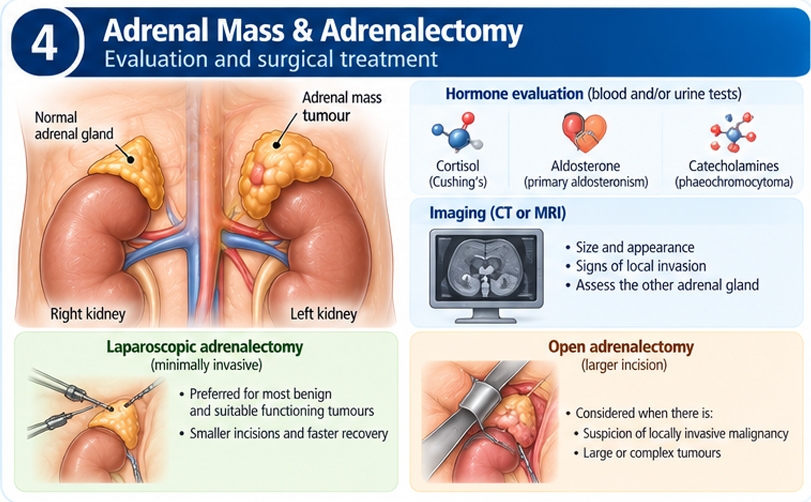
The adrenal glands sit above the kidneys. They produce several important hormones, including cortisol, aldosterone and adrenaline-like catecholamines. A tumour can therefore cause problems either because of hormone excess or because of concern about cancer.
What is an adrenal incidentaloma?
An incidentaloma is an adrenal mass found on imaging performed for another reason. The discovery itself does not mean cancer. Many are benign, non-functioning adenomas.
What tests are needed?
Evaluation usually combines dedicated imaging review with hormonal testing. Depending on the clinical situation, testing assesses cortisol excess, pheochromocytoma and primary aldosteronism, particularly in patients with
Why must pheochromocytoma be recognised before surgery?
Pheochromocytomas release catecholamines and can cause dangerous blood-pressure and heart-rate surges during an operation if not prepared properly. Preoperative alpha-blockade and specialist endocrine preparation are essential when pheochromocytoma is diagnosed.
Which adrenal masses need surgery?
Adrenalectomy is standard treatment for unilateral tumours causing clinically significant hormone excess. Surgery is also considered when imaging raises concern for malignancy or when an indeterminate lesion has sufficient clinical risk. Clearly benign, non-functioning, asymptomatic lesions generally do not need surgery.
Does size alone decide?
No. Size contributes to risk assessment but imaging characteristics, growth, hormone production, local invasion and the patient's overall situation are also important. Modern guidelines avoid using a single size threshold in isolation for every patient.
What is laparoscopic adrenalectomy?
Most benign and appropriately selected functioning adrenal tumours can be removed minimally invasively. Small incisions and a camera are used to free the adrenal gland from the kidney and surrounding structures and control its blood vessels.
When is open adrenalectomy preferred?
Open surgery is recommended when an adrenal mass is suspicious for malignancy and shows local invasion. The priority in suspected adrenal cancer is complete oncological removal without rupturing the tumour.
What happens with cortisol-producing tumours?
Removing a cortisol-producing adrenal tumour can temporarily leave the body unable to make enough cortisol because the opposite gland has been suppressed. Steroid replacement is therefore required around surgery and may continue until normal adrenal function recovers.
What happens with aldosterone-producing disease?
In unilateral primary aldosteronism, adrenalectomy can correct or improve excess aldosterone. Blood pressure often improves, although some patients still need antihypertensive medication afterwards. Potassium usually normalises.
What are the risks of adrenalectomy?
Risks include bleeding, infection, injury to nearby organs, blood clots and anaesthetic complications. Hormone-specific risks depend on the tumour. Experienced endocrine and surgical management is particularly important for pheochromocytoma and cortisol excess.
What is recovery like?
After minimally invasive adrenalectomy, mobilisation and oral intake usually begin early and hospital stay is often short. Recovery after open surgery is longer. Hormone levels, blood pressure, electrolytes and steroid requirements are monitored according to the tumour type.
What if my adrenal mass does not need surgery?
When imaging is clearly benign and hormonal assessment is reassuring, surgery is avoided. Follow-up requirements depend on the imaging phenotype, size, hormone findings and current guideline recommendations.
Frequently Asked Questions
Does every adrenal mass need a biopsy?
No. Adrenal biopsy has a limited role and must never be performed before pheochromocytoma has been excluded. It is not the routine test for distinguishing a benign adrenal adenoma from primary adrenal cancer.
Can I live normally with one adrenal gland?
Yes. A normal opposite adrenal gland is usually sufficient for long-term hormone production.
Is laparoscopic surgery always possible?
No. Minimally invasive surgery is preferred for many benign and selected non-invasive tumours, while suspected invasive adrenal cancer generally requires open oncological surgery.
The key message
Most adrenal masses do not need an operation. Surgery is directed mainly at clinically significant hormone-producing tumours and lesions with meaningful concern for malignancy. Careful hormonal preparation and the correct surgical approach are as important as removing the gland itself.
This article is for general patient education and does not replace individual endocrine, imaging or surgical assessment.
Dr. Mohammed Alassaf
Consultant Bariatric & Gastrointestinal Surgeon
Dr. Alassaf is a leading expert in minimally invasive and bariatric surgery,
with extensive experience helping patients overcome obesity and related conditions.
Having completed advanced training in Australia and the Middle East, he is known
for his compassionate approach and evidence-based surgical care.