Colorectal Cancer: Understanding Surgery and Treatment
Colorectal Cancer & Treatment
Colorectal Cancer: Understanding Surgery and Treatment
Dr-Alassaf
Nov 02, 2026
Being told that you have colorectal cancer naturally raises many questions: Do I need surgery? How much bowel will be removed? Will I need a stoma? Can the operation be done laparoscopically? Will I need chemotherapy? The answers depend on whether the cancer is in the colon or rectum, its stage, its exact location and your general health. For many patients with localised colorectal cancer, surgery remains the central treatment and may be curative.
What is colorectal cancer?
Colorectal cancer develops from the lining of the colon or rectum. Many cancers begin as polyps and gradually acquire changes that allow them to invade the bowel wall and, in some cases, spread to nearby lymph nodes or other organs. Colon and rectal cancers are related diseases, but their surgical treatment can differ because the rectum lies deep within the pelvis.
How is colorectal cancer diagnosed?
Colonoscopy is usually the key diagnostic test. It allows the tumour to be seen, biopsied and assessed for other lesions. Blood tests commonly include a full blood count, liver and kidney tests and a baseline CEA tumour marker. Once cancer is confirmed, CT of the chest, abdomen and pelvis is commonly used for staging. Rectal cancer additionally requires high-quality pelvic MRI because tumour depth, nodes, the mesorectal fascia and sphincter relationship can change the treatment plan.
What does 'stage' mean?
Broadly, early cancer is confined to the bowel wall; more advanced local disease extends through it; stage III involves regional lymph nodes; and stage IV has spread to distant organs such as the liver or lungs. Final pathological staging is often more accurate after surgery because the bowel and removed lymph nodes can be examined microscopically.
When is surgery used?
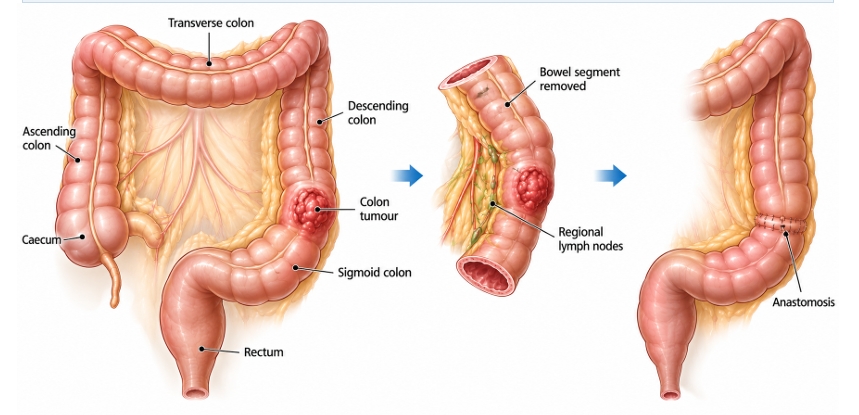
For most resectable colon cancers, surgery is the principal treatment. A proper cancer operation removes the tumour-bearing bowel segment together with appropriate healthy margins, its blood supply, mesentery and regional lymph nodes. Lymph-node removal treats potential microscopic regional disease and provides accurate staging. Stage helps determine whether surgery alone may be sufficient or whether chemotherapy, radiotherapy or another treatment should be added
How much colon is removed?
The amount removed is determined by tumour location and vascular and lymphatic drainage. A right-sided cancer may require right hemicolectomy; a left or sigmoid cancer requires the corresponding left-sided or sigmoid resection. Removing more bowel is not automatically better: the correct operation achieves sound margins and lymphatic clearance while preserving healthy bowel.
How is the bowel reconnected?
The two healthy bowel ends can usually be joined with an anastomosis, constructed with sutures or stapling devices. The surgeon checks blood supply and ensures the ends meet without excessive tension. A major early complication is anastomotic leak, where the new join fails to heal completely.
Will I need a stoma?
Most patients having elective colon-cancer surgery do not require a permanent stoma. A temporary ileostomy may protect a low rectal anastomosis. A permanent colostomy is occasionally necessary when a very low rectal tumour prevents safe sphincter-preserving cancer clearance. Stomas are also more likely in some emergency operations involving obstruction, perforation or severe contamination.
Laparoscopic or open surgery?
When expertise is available and the tumour is suitable, minimally invasive colectomy is preferred for many elective colon cancers. It uses several small incisions and a camera, but the internal cancer operation must follow the same oncological principles as open surgery. Open surgery remains appropriate for locally extensive tumours, difficult anatomy or whenever it is the safer approach. Conversion from laparoscopy is a safety decision, not a failure.
What is different about rectal cancer?
Rectal cancer has its own pathway because the rectum lies within the pelvis beside the bladder, reproductive organs, pelvic nerves and anal sphincter. Many rectal operations require precise removal within the mesorectal envelope - total mesorectal excision (TME). Depending on MRI stage and tumour location, chemotherapy and/or radiotherapy may be recommended before surgery.
Do I need chemotherapy before surgery?
For a straightforward resectable colon cancer, surgery is commonly performed first. Neoadjuvant chemotherapy may be considered for selected locally advanced colon cancers. For rectal cancer, preoperative treatment is more common and is determined by MRI-defined risk and multidisciplinary planning.
Will I need chemotherapy after surgery?
Final pathology guides this decision. Stage III colon cancer commonly requires postoperative chemotherapy if the patient is fit. In stage II disease, chemotherapy is selective and depends on pathological and clinical risk factors. Very early cancers may need no additional treatment.
What if the cancer has spread to the liver or lungs?
Metastatic colorectal cancer does not automatically mean surgery has no role. Some patients with limited liver or lung metastases can undergo treatment of both the primary cancer and metastatic disease with curative intent. The sequence may include chemotherapy, colorectal surgery, liver or lung surgery, ablation or combinations of these treatments.
What happens before the operation?
Preparation includes review of medical conditions and medicines, blood tests and anaesthetic assessment. Nutrition, smoking cessation, diabetic control, physical activity and treatment of anaemia can influence recovery. The surgeon should explain the planned resection, anastomosis, possibility of a stoma and important complications.
What should I expect after surgery?
Modern colorectal recovery encourages early mobilisation and oral intake when appropriate. Pain control, blood-clot prevention and breathing exercises are important. The bowel may take time to resume normal activity, and temporary bloating or altered bowel frequency are common.
What are the important risks?
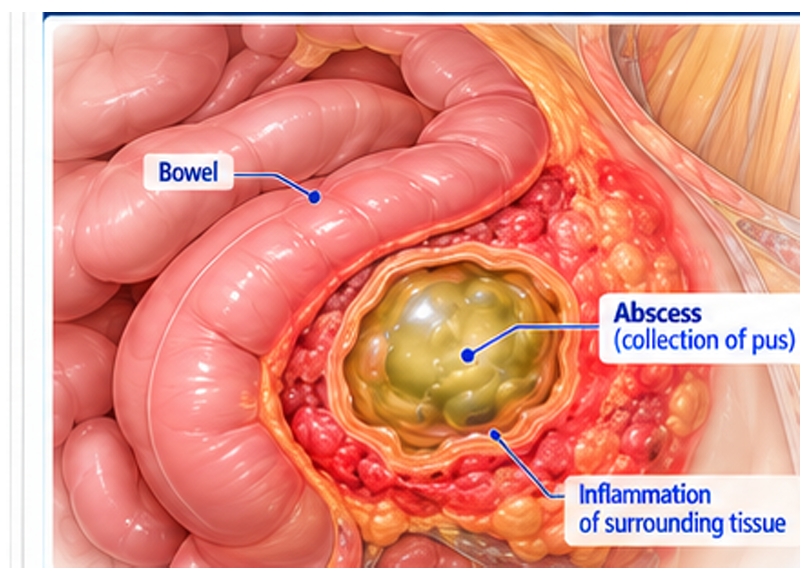
General risks include bleeding, infection, blood clots, chest and cardiovascular complications. Specific risks include anastomotic leak, intra-abdominal infection or collection, ileus, bowel obstruction, injury to nearby structures and incisional hernia. Individual risk varies with the operation, age, fitness, cancer stage and other medical conditions.
What happens after I leave hospital?
Recovery continues for several weeks. Walking should increase progressively, nutrition and hydration remain important and fatigue can persist after major cancer surgery. At follow-up, final pathology determines the definitive stage, whether chemotherapy should be discussed and the surveillance programme.
Frequently Asked Questions
Does colon cancer always require bowel resection?
Most invasive, resectable colon cancers are treated by segmental oncological resection. A very early malignant polyp completely removed endoscopically with favourable pathological features may sometimes avoid bowel surgery.
How many lymph nodes should be removed?
The regional lymph-node-bearing mesentery is removed anatomically. Examination of at least 12 lymph nodes is a widely accepted staging quality benchmark, although surgery is based on proper lymphatic clearance rather than simply reaching a number.
Will removing part of my colon affect digestion?
Most patients adapt well after segmental colectomy. Stool frequency and consistency can change, especially early after surgery, but major long-term nutritional problems are uncommon after standard colon resection.
Can I have laparoscopic surgery if the tumour is large?
Possibly. Tumour size alone does not decide the approach; local invasion, anatomy, previous operations and the ability to perform a safe cancer resection are more important.
If surgery converts from laparoscopic to open, has something gone wrong?
Not necessarily. Conversion can be the safest response to difficult anatomy, bleeding, adhesions or unexpectedly advanced disease.
Does surgery guarantee the cancer will not return?
No. Surgery can be curative, particularly for earlier-stage disease, but recurrence risk depends on stage and tumour biology. Appropriate additional treatment and surveillance remain important.
The key message
Colorectal cancer surgery is more than removal of the visible tumour. A proper oncological operation removes the correct bowel segment together with its regional lymphatic drainage, then restores bowel continuity whenever this can be done safely. The exact plan - laparoscopic or open, colon or rectal surgery, anastomosis or stoma, surgery first or treatment first - is determined by tumour location, stage and the individual patient.
This article is for general patient education and does not replace individual cancer staging, multidisciplinary review or advice from your treating surgical team.
Dr. Mohammed Alassaf
Consultant Bariatric & Gastrointestinal Surgeon
Dr. Alassaf is a leading expert in minimally invasive and bariatric surgery,
with extensive experience helping patients overcome obesity and related conditions.
Having completed advanced training in Australia and the Middle East, he is known
for his compassionate approach and evidence-based surgical care.