A femoral hernia is a type of groin hernia that develops through the femoral canal, a small space just below the inguinal ligament at the top of the thigh. It is less common than an inguinal hernia, but it deserves particular attention because it has a greater tendency to become trapped or strangulated.
For this reason, a confirmed femoral hernia is generally treated differently from a small, minimally symptomatic inguinal hernia. International groin-hernia guidance recommends timely repair rather than prolonged watchful waiting.
Where is a femoral hernia?
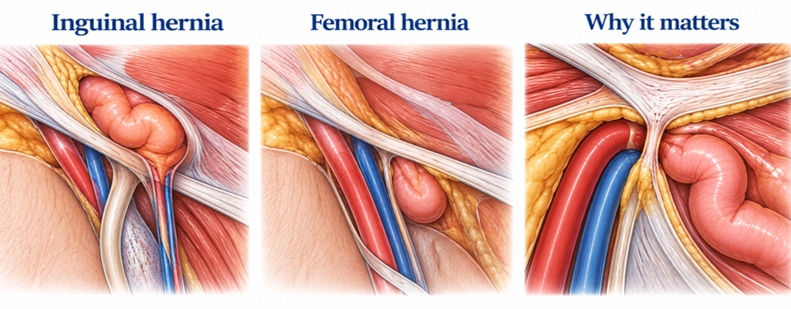
The groin contains several closely related anatomical spaces. An inguinal hernia passes through the inguinal region above the inguinal ligament. A femoral hernia passes through the femoral canal below the ligament, close to the major blood vessels supplying the leg.
Because these two hernias arise very close to each other, distinguishing them by appearance or examination is not always straightforward.
Why is a femoral hernia more concerning?
The opening of the femoral canal is relatively narrow and rigid. A small amount of fat or bowel can enter this space and then become difficult to push back.
This is why femoral hernias are more likely than inguinal hernias to become incarcerated (trapped) or strangulated (the blood supply to the trapped tissue is compromised). If bowel is involved, strangulation can become a surgical emergency.
Who gets femoral hernias?
Femoral hernias can occur in both men and women, but they are proportionally more common in women. This is clinically important because a groin lump in a woman that appears to be an inguinal hernia may actually be femoral.
Current international guidance therefore recommends considering a femoral hernia whenever a woman presents with a groin hernia and favours a preperitoneal laparo-endoscopic approach when appropriate expertise is available, because this allows the surgeon to inspect and cover both the inguinal and femoral regions.
What symptoms does a femoral hernia cause?
Some patients notice a small lump or swelling at the upper inner thigh or groin. It may be uncomfortable during standing, coughing or activity. In other patients, the hernia is difficult to see or feel and may first become apparent when it becomes painful.
Because the defect can be small, the size of the external lump does not necessarily reflect the importance of the hernia.
When is it an emergency?
Seek urgent medical assessment if a groin lump becomes suddenly painful, firm or irreducible, especially if this is accompanied by nausea, vomiting, abdominal pain or abdominal distension.
An acutely irreducible groin hernia can be life-threatening. If strangulation is suspected, current HerniaSurge guidance recommends immediate emergency surgery.
How is a femoral hernia diagnosed?
The diagnosis often begins with examination while standing and lying down. However, because femoral and inguinal hernias can be difficult to distinguish clinically, imaging may sometimes help.
Ultrasound can be useful for an uncertain groin lump. CT or MRI may be considered when the diagnosis remains unclear, when anatomy is complex or when another cause of groin pain is being investigated.
In an emergency, the clinical picture is most important and imaging should not unnecessarily delay treatment when strangulation is suspected.
Does a femoral hernia need surgery?
In general, yes. Unlike some minimally symptomatic inguinal hernias for which observation can sometimes be considered, timely elective repair is recommended for femoral hernias because of their greater risk of incarceration and strangulation.
Elective surgery allows the repair to be planned under controlled circumstances rather than waiting for an emergency presentation.
How is a femoral hernia repaired?
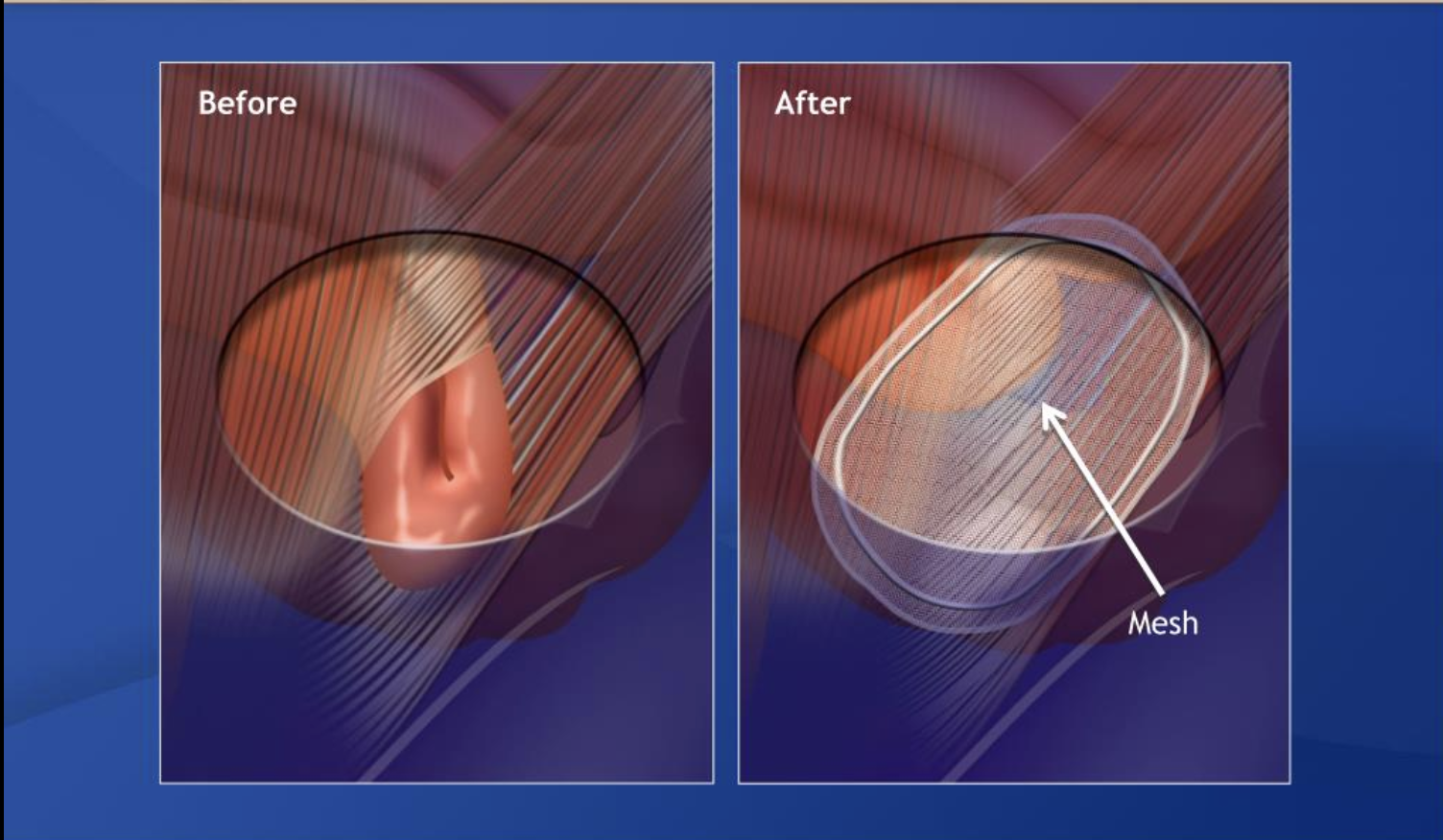
The hernia contents are reduced and the femoral defect is covered or closed so that tissue cannot protrude through it again. Mesh is commonly used to reinforce the groin.
The repair can be performed through an open operation or through a laparo-endoscopic preperitoneal approach such as TEP or TAPP. When expertise is available, international guidance favours a laparo-endoscopic mesh repair for elective femoral hernia because the preperitoneal view exposes the entire myopectineal orifice, including the femoral canal.
TEP or TAPP?
Both TEP and TAPP place mesh in the preperitoneal space and can cover the femoral as well as the inguinal defects. The difference is how that space is reached.
With TEP, the repair is performed without deliberately entering the abdominal cavity. With TAPP, the abdominal cavity is entered first and the peritoneum is opened to reach the preperitoneal space. The choice depends on the clinical situation, previous surgery, anatomy and the surg
What happens if bowel is trapped?
If a femoral hernia presents acutely and bowel is trapped, the priority is to assess whether that bowel is still healthy. If its blood supply has been compromised, the affected segment may occasionally need to be removed.
This is the main reason not to ignore a known femoral hernia. Planned elective repair is usually a very different situation from emergency surgery for strangulated bowel.
Frequently Asked Questions
Is a femoral hernia the same as an inguinal hernia?
No. Both are groin hernias, but they pass through different anatomical spaces. A femoral hernia emerges through the femoral canal below the inguinal ligament.
Are femoral hernias more common in women?
Yes. Femoral hernias occur proportionally more often in women, and femoral hernia should be specifically considered when assessing a woman with a groin lump.
Can I watch a femoral hernia if it does not hurt?
Long-term watchful waiting is generally not recommended for a confirmed femoral hernia. Timely elective repair is advised because femoral hernias have a greater risk of becoming trapped or strangulated than inguinal hernias.
Can a femoral hernia be repaired with TEP?
Yes. TEP provides access to the preperitoneal space and allows mesh to cover the femoral canal as part of the entire groin repair. TAPP is another established preperitoneal approach.
Do all femoral hernias contain bowel?
No. The hernia may contain preperitoneal fat or other tissue. Bowel can enter the hernia, however, and the narrow femoral canal makes bowel trapping particularly important.
If I have severe groin pain but no obvious lump, could it still be a femoral hernia?
Possibly. Some femoral hernias are small or difficult to feel. Persistent or acute groin pain requires clinical assessment, with imaging used when appropriate.
The key message
A femoral hernia is uncommon, but it should not be treated as an insignificant groin lump.
Its narrow anatomical opening makes incarceration and strangulation more likely than with an inguinal hernia. This is particularly important in women, in whom femoral hernias occur more frequently and can sometimes be mistaken for inguinal hernias.
Once a femoral hernia is confirmed, timely repair is generally recommended. A preperitoneal TEP or TAPP repair can cover the femoral and inguinal regions with mesh, while the precise approach should be individualized to the patient and the clinical situation.
This article is for general educational purposes and does not replace an individualized consultation with a qualified surgeon.
Dr. Mohammed Alassaf
Consultant Bariatric & Gastrointestinal Surgeon
Dr. Alassaf is a leading expert in minimally invasive and bariatric surgery,
with extensive experience helping patients overcome obesity and related conditions.
Having completed advanced training in Australia and the Middle East, he is known
for his compassionate approach and evidence-based surgical care.