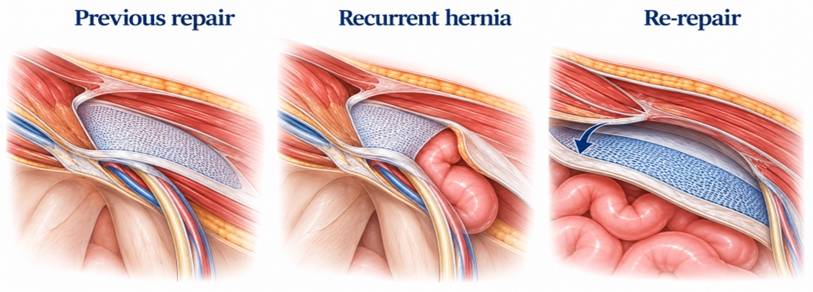
A hernia can occasionally return after a previous repair. This is called a recurrent hernia. It does not necessarily mean that the original operation was performed incorrectly. Hernia repair depends on the strength of living tissue, and that tissue continues to be exposed to pressure, healing, ageing and changes in the body long after surgery.
The important question is not simply why did it come back? It is also: what was repaired before, where is the recurrence now, and what is the best anatomical plane for the next repair?
What is a recurrent hernia?
A recurrent hernia is a new defect or bulge that develops at, or close to, the site of a previous hernia repair. It can occur after an inguinal hernia repair or after repair of an umbilical, ventral or incisional hernia.
Recurrence may appear relatively soon after surgery, but it can also occur years later. The new defect may be small and minimally symptomatic, or it may gradually enlarge and cause discomfort, pressure or limitation of activity.
Why can a hernia come back?
There is rarely one single explanation. Recurrence usually reflects a combination of the original hernia, the quality of the patient's tissues, healing, abdominal pressure and the details of the previous repair.
Factors can include: a large or complex original defect; weak or stretched abdominal-wall tissue; wound infection; obesity; smoking; poorly controlled diabetes; repeated heavy straining or chronic cough; and technical factors related to the previous repair, including mesh size, position, fixation or failure to obtain adequate tissue overlap.
For incisional hernias, recurrence becomes more difficult after each failed repair, which is why careful planning before another operation is particularly important.
Does recurrence mean the mesh failed?
Not necessarily. A recurrent hernia can occur beside the edge of a mesh, through an inadequately covered area, or because the surrounding abdominal wall has continued to stretch. In other situations, the previous repair may have been performed without mesh.
The existing mesh may be well incorporated and may not need to be removed. Mesh removal is a separate decision and is generally considered only when there is a specific reason, such as infection or another mesh-related problem.
How is a recurrent hernia investigated?
The first step is a careful history and examination. I want to know what operation was performed previously, whether mesh was used, where it was placed, and whether there were postoperative problems such as infection.
Previous operative reports are very helpful when available. Imaging is not required for every small groin recurrence, but ultrasound, CT or MRI may be useful when the diagnosis is uncertain or the anatomy is complex.
For recurrent or complex ventral and incisional hernias, CT is particularly useful for showing the size and number of defects, the abdominal-wall muscles, previous mesh and the relationship of the hernia to surrounding structures.
Why might the second operation use a different approach?
This is especially important in recurrent inguinal hernia surgery. Operating repeatedly through the same scarred tissue can make dissection more difficult and can increase the risk of injury to nerves, blood vessels and the spermatic cord.
For that reason, the preferred strategy is often to approach the recurrence through a different anatomical plane from the previous repair.
For example, after a previous open anterior groin repair, a posterior preperitoneal repair such as TEP or TAPP is commonly considered. Conversely, if the previous repair was TEP or TAPP and the posterior preperitoneal space has already been dissected, an open anterior repair may be more appropriate.
The exact operation still depends on the previous technique, the anatomy of the recurrence and the surgeon's expertise.
What about a recurrent ventral or incisional hernia?
Recurrent ventral and incisional hernias require a broader assessment of the abdominal wall. The surgeon needs to understand not only the visible defect but also the previous incision, the position of any existing mesh, the quality of the rectus muscles, the width of the defect and whether the midline can be reconstructed.
The next repair may be open, laparoscopic or robotic depending on the individual anatomy. The aim is generally to restore the abdominal wall, close the fascial defect when feasible and reinforce the repair appropriately rather than simply cover a bulge.
Can anything be done to reduce the risk of another recurrence?
Some factors cannot be changed, but others can be improved before elective surgery. Weight optimization, stopping smoking, good diabetic control and treatment of chronic cough can all improve the environment in which the repair must heal.
For larger incisional hernias, this preparation can be an important part of the operation rather than an optional extra. The goal is to reduce wound complications and give the reconstruction the best chance of durable healing.
Does every recurrent hernia need another operation?
No. The decision depends on symptoms, size, progression, the risk of complications, general health and the complexity of another repair.
A small, reducible and minimally symptomatic recurrence may sometimes be observed. A painful or enlarging recurrence, or one that significantly affects daily life, is more likely to lead to discussion of another repair.
A suddenly painful lump that cannot be pushed back, particularly when associated with vomiting or abdominal distension, requires urgent medical assessment.
Frequently Asked Questions
Can a hernia come back even after mesh repair?
Yes. Mesh significantly strengthens many hernia repairs, but no operation can guarantee a zero recurrence rate. Recurrence may occur at the edge of a previous repair or because the surrounding tissue changes over time.
Does the old mesh always have to be removed?
No. If the existing mesh is well incorporated and is not infected or causing a specific problem, it may be left in place. The decision is made from the anatomy and findings in each individual case.
Is a recurrent hernia more difficult to repair?
It can be. Scar tissue, altered anatomy and previous mesh can make re-operation more complex. This is one reason why knowing the details of the first operation and choosing the appropriate surgical plane are important.
If my first inguinal hernia was repaired open, can the recurrence be repaired laparoscopically?
Often, yes. A posterior preperitoneal approach such as TEP or TAPP is commonly used after a previous anterior repair because it approaches the hernia from a different tissue plane. Individual anatomy and previous operations still matter.
Do I need a CT scan before recurrent hernia surgery?
Not every patient does. CT is particularly useful for recurrent ventral or incisional hernias and for complex anatomy. Some recurrent groin hernias can be diagnosed clinically, with ultrasound or other imaging used when needed.
The key message
A recurrent hernia is not simply the same operation performed again.
The surgeon needs to understand why the repair may have failed, what tissue planes and mesh were used previously, and how the anatomy has changed. For recurrent groin hernias, using a different anatomical approach from the previous repair is often important. For recurrent ventral or incisional hernias, careful imaging and reconstruction planning may be necessary.
The objective is not only to close the recurrent defect, but to create the most durable repair possible while avoiding unnecessary dissection through scarred tissue.
This article is for general educational purposes and does not replace an individualized consultation with a qualified surgeon
Dr. Mohammed Alassaf
Consultant Bariatric & Gastrointestinal Surgeon
Dr. Alassaf is a leading expert in minimally invasive and bariatric surgery,
with extensive experience helping patients overcome obesity and related conditions.
Having completed advanced training in Australia and the Middle East, he is known
for his compassionate approach and evidence-based surgical care.