Gastro-oesophageal reflux disease (GERD) and hiatal hernia are especially important when planning bariatric
surgery because the choice of operation can improve reflux in one patient but worsen it in another. For this reason,
reflux is not a minor side issue in procedure selection - it is one of the factors I consider most carefully.
Sleeve gastrectomy and Roux-en-Y gastric bypass change the anatomy around the stomach and oesophagus in
very different ways. Understanding these differences helps explain why I generally favour gastric bypass when a
patient has significant established reflux.
What is gastro-oesophageal reflux?
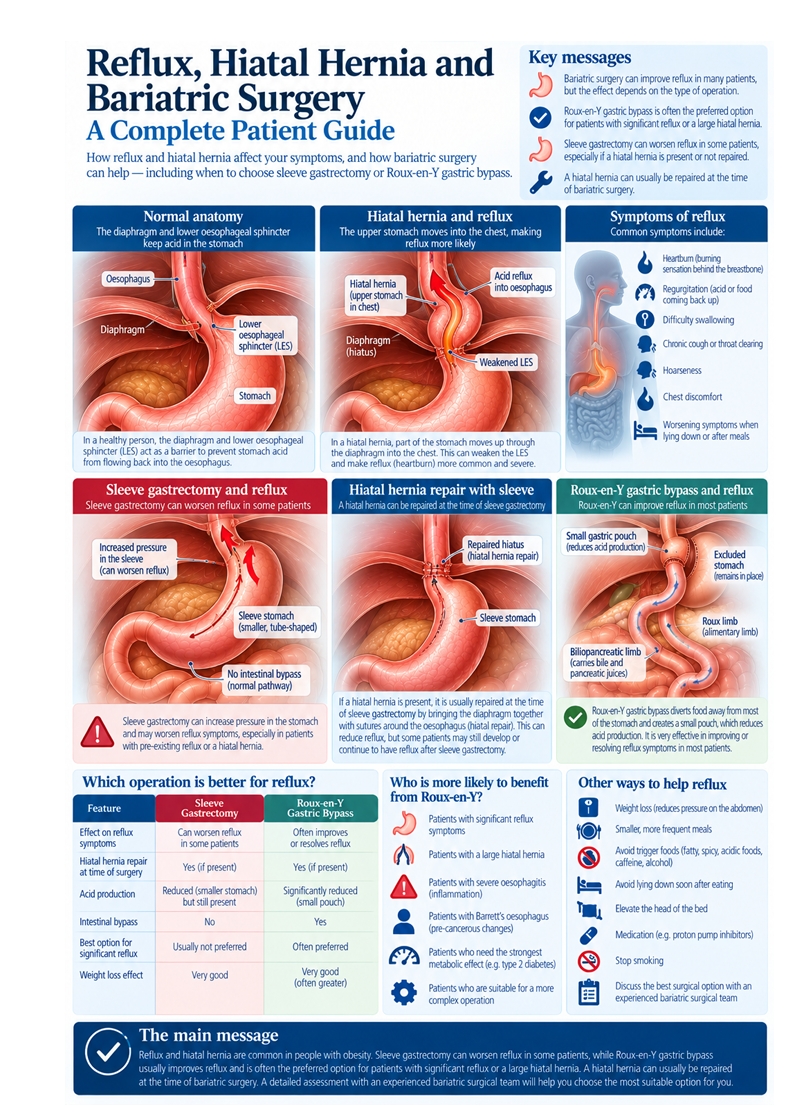
Reflux occurs when stomach contents repeatedly travel upward into the oesophagus. Typical symptoms include
heartburn and regurgitation, but some patients develop chest discomfort, chronic cough, throat clearing, hoarseness
or swallowing symptoms. Repeated reflux can inflame the oesophageal lining.
What is a hiatal hernia?
The oesophagus normally passes through an opening in the diaphragm called the hiatus before joining the stomach.
A hiatal hernia occurs when the gastro-oesophageal junction or part of the stomach moves upward through this
opening into the chest. This can weaken the normal anti-reflux mechanism.
Why obesity and reflux often occur together
Increased abdominal pressure, altered anatomy at the gastro-oesophageal junction and the presence of hiatal
hernia can all contribute. Weight loss itself can improve reflux in some patients, but the anatomical effect of the
bariatric operation remains crucial.
Why reflux matters before choosing sleeve or bypass
Sleeve gastrectomy can worsen existing GERD or produce new reflux in some patients. Roux-en-Y gastric bypass
usually has a more favourable reflux profile. The patient's reflux history therefore directly influences my
recommendation
Why sleeve gastrectomy can worsen reflux
Sleeve creates a narrow, relatively high-pressure stomach. It also changes the geometry around the angle of His
and gastro-oesophageal junction. In susceptible patients these changes can promote reflux even when weight loss
itself is beneficial.
Can reflux appear for the first time after sleeve?
Yes. Some patients who had little or no reflux before surgery develop new symptoms afterwards. This is one reason
preoperative counselling should include reflux as a long-term consideration rather than focusing only on weight loss.
What happens if a hiatal hernia is found?
In my practice, a hiatal hernia is repaired when present. The stomach and distal oesophagus are restored to their
appropriate position and the diaphragmatic crura are approximated to reconstruct the hiatus.
Does hiatal hernia repair make sleeve an anti-reflux operation?
No. Repairing a hiatal hernia corrects an anatomical defect, but sleeve anatomy can still promote reflux. A patient
with significant established GERD may therefore still be better served by Roux-en-Y gastric bypass.
Why Roux-en-Y can improve reflux
Roux-en-Y creates a small gastric pouch and diverts food away from most of the acid-producing stomach. Bile and
pancreatic secretions meet the food further downstream. This anatomy generally reduces both acid and bile
exposure at the oesophagus.
When I tend to favour gastric bypass
Significant symptomatic reflux, severe oesophagitis or other important reflux-related findings make Roux-en-Y
particularly attractive. The final decision still considers the patient's full medical, nutritional and operative profile.
Why endoscopy can be important
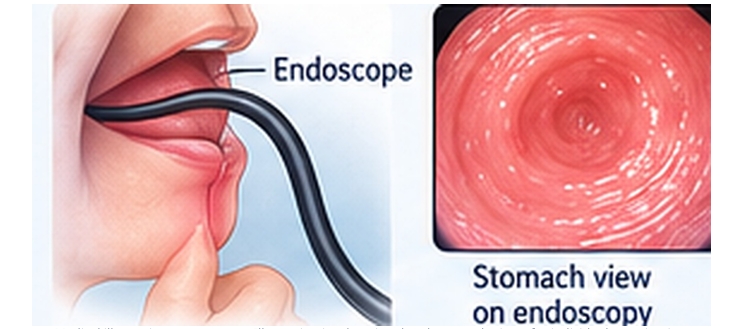
Upper endoscopy can identify oesophagitis, Barrett's oesophagus, ulceration, hiatal hernia and other pathology.
Findings may influence whether sleeve is appropriate and whether further reflux evaluation is required.
What is Barrett's oesophagus?
Barrett's oesophagus is a change in the lining of the lower oesophagus associated with chronic reflux. It requires
appropriate gastroenterological assessment and surveillance and is an important consideration when selecting a
bariatric operation.
What if reflux develops after sleeve?
Initial treatment commonly includes lifestyle measures and PPI therapy. Persistent or severe symptoms require
investigation rather than simply escalating medication indefinitely. Endoscopy and imaging can assess oesophagitis,
recurrent hiatal hernia, sleeve stenosis, angulation or twisting.
When is conversion from sleeve to bypass considered?
Conversion to Roux-en-Y is an established revisional strategy for selected patients with medically refractory GERD
after sleeve, particularly when investigation confirms a problem that bypass anatomy is well suited to address.
Could hiatal hernia repair alone be enough after sleeve?
In selected patients it may be considered, depending on BMI, anatomy, the size of the hernia and the mechanism of
reflux. There is no single revisional solution for every patient.
Lifestyle measures still matter
Weight management, smaller meals, avoiding lying down soon after eating, identifying trigger foods, stopping
smoking and elevating the head of the bed can help some patients. These measures complement rather than
replace investigation of significant postoperative reflux.
The role of PPI medication
Proton-pump inhibitors reduce acid production and are effective for many patients with GERD. I also routinely
prescribe a PPI during the postoperative healing period after bariatric surgery. Long-term treatment is individualised.
Why swallowing difficulty needs assessment
Progressive dysphagia, repeated vomiting or food sticking should not simply be labelled as reflux. These symptoms
can indicate stenosis, angulation, motility problems or other pathology and warrant investigation.
Why long-term follow-up matters
Reflux symptoms can change as weight changes and postoperative anatomy adapts. Long-term follow-up allows
persistent GERD, nutritional issues and anatomical problems to be identified and treated appropriately.
My approach to reflux and hiatal hernia
Reflux is a major part of my bariatric procedure selection. In a patient without significant reflux, sleeve
gastrectomy may be an excellent option. When significant established reflux is present, I generally prefer
Roux-en-Y gastric bypass. If a hiatal hernia is identified, I repair it during the bariatric operation. I also
routinely perform an intraoperative leak test, and the wider pathway includes dietitian assessment,
metabolic screening, a preoperative liver-reduction diet, postoperative PPI therapy and two weeks of DVT
prophylaxis.
Frequently Asked Questions
If I have reflux, can I still have bariatric surgery?
Yes. In fact, the presence of reflux can help determine which bariatric operation is most appropriate.
Does sleeve always cause reflux?
No. Many patients do well after sleeve, but new or worsening GERD is a recognised possibility.
If I have a hiatal hernia, does it always need repair?
When a clinically relevant hiatal hernia is present during bariatric surgery, I repair it as part of the operation.
Does hiatal repair guarantee that reflux will disappear?
No. Reflux has several mechanisms, and sleeve anatomy itself can contribute.
Is gastric bypass guaranteed to cure reflux?
No operation guarantees complete symptom resolution, although Roux-en-Y is generally favourable for significant
GERD.
Why might I need an endoscopy before surgery?
Endoscopy can reveal oesophagitis, Barrett's oesophagus, ulceration, hiatal hernia or other pathology that can
influence procedure selection.
What if I develop severe reflux after sleeve?
You should be assessed. Treatment may range from medication and lifestyle measures to endoscopic treatment,
hiatal repair or conversion to Roux-en-Y depending on the cause.
Can reflux cause swallowing difficulty?
It can, but dysphagia may also indicate another problem and deserves investigation.
Can I stay on PPI indefinitely?
Some patients require long-term therapy, but the indication and dose should be reviewed rather than assumed.
Why does my original bariatric operation matter when reflux is assessed years later?
Because sleeve and bypass create very different anatomy and therefore different possible causes and treatments
for reflux.
The key message
Reflux and hiatal hernia should be considered before the bariatric operation is chosen. Sleeve gastrectomy
can worsen reflux in some patients, while Roux-en-Y gastric bypass generally has a more favourable reflux
profile. In my practice, significant reflux usually favours bypass, and a hiatal hernia is repaired when
present.
Patient-information note: reflux assessment and bariatric procedure selection are individualised. Persistent reflux, dysphagia, bleeding, repeated
vomiting or unexplained chest or abdominal symptoms require appropriate medical assessment.
Dr. Mohammed Alassaf
Consultant Bariatric & Gastrointestinal Surgeon
Dr. Alassaf is a leading expert in minimally invasive and bariatric surgery,
with extensive experience helping patients overcome obesity and related conditions.
Having completed advanced training in Australia and the Middle East, he is known
for his compassionate approach and evidence-based surgical care.