Sigmoid Volvulus: When a Twisted Colon Becomes an Emergency
Bowel Obstruction, Sigmoid Volvulus & Emergency Colorectal Surgery
Sigmoid Volvulus: When a Twisted Colon Becomes an Emergency
Dr-Alassaf
Nov 03, 2026
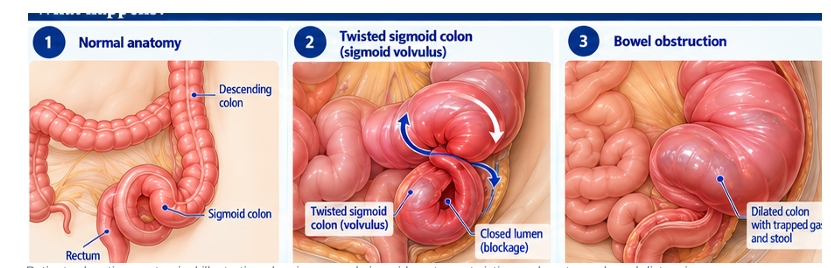
Sigmoid volvulus occurs when the sigmoid colon twists around its supporting tissue, obstructing the
passage of stool and gas. It may also compromise blood supply, making timely assessment essential.
What happens when the colon twists?
A long, mobile sigmoid colon can rotate on its mesentery. This closes the bowel lumen and can compress its
vessels. The colon above the twist becomes distended; prolonged vascular compromise can cause gangrene or
perforation.
Who is at risk?
It occurs more often in older adults and people with chronic constipation, reduced mobility or certain neurological
conditions. It can also occur in younger patients with an unusually long sigmoid colon.
What symptoms should prompt urgent care?
Marked abdominal distension, cramping pain, inability to pass stool or gas, vomiting and worsening discomfort are
typical. Fever, constant severe pain, tenderness or shock may indicate ischaemia or perforation.
How is it diagnosed?
Abdominal imaging may show a markedly dilated loop; CT helps identify the twist, bowel viability and
complications. Blood tests support assessment but cannot reliably rule out bowel ischaemia.
Can the bowel be untwisted without surgery?
In a stable patient without suspected perforation or dead bowel, flexible sigmoidoscopy may decompress and
untwist the colon. A rectal tube may be placed temporarily. Endoscopic success does not remove the underlying
tendency to twist again.
When is emergency surgery required?
Peritonitis, perforation, suspected gangrenous bowel, failed endoscopic detorsion or worsening instability generally
require urgent operation. The affected sigmoid colon is usually removed; reconnection or stoma depends on bowel
viability and patient condition.
Why is elective surgery often discussed after successful decompression?
Recurrence after endoscopic treatment alone is common. For patients who can tolerate surgery, sigmoid resection
during the same admission or after optimisation may provide more definitive prevention.
What is recovery like?
Recovery depends on whether the bowel was viable, whether an operation was necessary and the patient's
baseline health. Stoma care, mobilisation, hydration and bowel function are important after resection.
Frequently asked questions
Can constipation treatment prevent all episodes?
No. Managing constipation helps general bowel health but does not reliably prevent recurrence once volvulus has
occurred.
Is colonoscopy safe in everyone?
No. Endoscopic detorsion is inappropriate when perforation or nonviable bowel is suspected.
Is a stoma always necessary?
No. A primary join may be possible when the patient is stable and the bowel is healthy.
The key message
A twisted sigmoid colon can be relieved endoscopically in selected patients, but recurrent twisting and bowel
ischaemia make definitive surgical planning important.
Dr. Mohammed Alassaf
Consultant Bariatric & Gastrointestinal Surgeon
Dr. Alassaf is a leading expert in minimally invasive and bariatric surgery,
with extensive experience helping patients overcome obesity and related conditions.
Having completed advanced training in Australia and the Middle East, he is known
for his compassionate approach and evidence-based surgical care.