Perforated Diverticulitis: Hartmann’s Procedure or Primary Anastomosis?
Diverticular Disease, Diverticulitis & Emergency Colorectal Surgery
Perforated Diverticulitis: Hartmann’s Procedure or Primary Anastomosis?
Dr-Alassaf
Nov 03, 2026
When a diverticulum perforates, infection may remain localised or spread through the abdominal cavity. The operation, if one is needed, depends on the severity of contamination and the patient’s condition.
What does perforated diverticulitis mean?
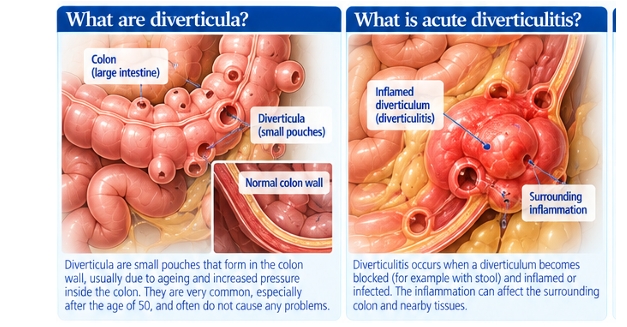
Diverticula are small pouches in the colon wall. Inflammation can occasionally produce a hole, allowing air, bacteria or bowel contents to escape. A contained perforation can form an abscess; free perforation may cause generalised peritonitis.
Does every perforation need an operation?
No. Stable patients with selected contained perforations may respond to antibiotics and observation, sometimes with image-guided drainage of an abscess. Generalised peritonitis, uncontrolled sepsis or clinical deterioration generally calls for urgent surgical source control.
How is the diagnosis made?
Contrast-enhanced CT usually demonstrates inflammation, extraluminal gas, collections and the extent of contamination. Blood tests and repeated clinical examinations help assess severity. Resuscitation and antibiotics should not be delayed in an unstable patient.
What is Hartmann’s procedure?
The diseased sigmoid colon is removed, the downstream rectal stump is closed, and the upstream colon is brought to the skin as an end colostomy. This avoids making a bowel join in a patient for whom healing would be unsafe. The colostomy may be reversible, but reversal is not guaranteed.
What is resection with primary anastomosis?
The diseased colon is removed and the healthy ends are joined. In selected patients, surgeons may protect the join with a temporary diverting ileostomy. This option is increasingly considered in physiologically stable patients when tissue quality and operative circumstances are favourable.
How does the surgeon choose?
The choice reflects haemodynamic stability, organ dysfunction, degree of contamination, tissue quality, immunosuppression, other illness and surgical expertise. A very unwell patient may benefit from a shorter, safer damage-control approach rather than a complex reconstruction.
Can laparoscopic surgery be used?
Laparoscopy may be feasible in carefully selected patients and experienced hands. Extensive contamination, difficult anatomy or instability can make open surgery preferable. Conversion is a safety decision.
What happens after surgery?
Recovery includes infection monitoring, pain relief, early mobilisation and gradual nutrition. A stoma nurse supports patients who have a colostomy or ileostomy. Follow-up colon evaluation is often recommended after the acute episode when appropriate, especially if the colon has not recently been assessed.
Frequently asked questions
Is a stoma always permanent?
No, but reversal depends on recovery, remaining bowel, overall health and the risks of a second operation.
Which operation is best?
There is no universal answer; stable and unstable patients may require very different operations.
Can diverticulitis return?
Recurrence is possible in remaining colon, although removal of the affected segment lowers recurrence at that site.
The key message
The priority is to control contamination and keep the patient safe. Hartmann’s procedure and primary anastomosis are both valid options in appropriately selected circumstances.
This article is general patient education, not a substitute for assessment or personalised surgical advice. Seek emergency medical care for severe or rapidly worsening symptoms.
Dr. Mohammed Alassaf
Consultant Bariatric & Gastrointestinal Surgeon
Dr. Alassaf is a leading expert in minimally invasive and bariatric surgery,
with extensive experience helping patients overcome obesity and related conditions.
Having completed advanced training in Australia and the Middle East, he is known
for his compassionate approach and evidence-based surgical care.