Thyroid Cancer: Understanding Surgery and Treatment
Thyroid Cancer & Thyroid Surgery
Thyroid Cancer: Understanding Surgery and Treatment
Dr-Alassaf
Nov 03, 2026
A diagnosis of thyroid cancer can be frightening, but most differentiated thyroid cancers - particularly papillary thyroid
cancer - have an excellent outlook. Treatment is increasingly tailored to the biological risk of the cancer. This means
that not every patient needs the entire thyroid removed, not every patient needs lymph-node surgery, and not every
patient needs radioactive iodine.
What types of thyroid cancer are we talking about?
The common differentiated thyroid cancers include papillary, follicular and oncocytic thyroid cancers. Papillary thyroid
cancer is by far the most common. Medullary and anaplastic thyroid cancers are biologically different diseases and
follow different treatment pathways; this article focuses mainly on differentiated thyroid cancer.
How is thyroid cancer diagnosed?
A suspicious thyroid nodule is assessed with ultrasound and usually ultrasound-guided fine-needle aspiration (FNA).
The neck ultrasound should also evaluate lymph nodes. In some cases the exact diagnosis becomes clear only after a
thyroid lobe has been removed and examined by a pathologist.
Is surgery always the first treatment?
Surgery remains the usual first treatment for differentiated thyroid cancer. However, carefully selected very small,
low-risk papillary cancers can sometimes be monitored with active surveillance rather than operated on immediately.
The choice depends on tumour features, location, patient factors and the ability to provide reliable follow-up.
What has changed in modern thyroid-cancer surgery?
Older treatment strategies frequently favoured total thyroidectomy for most cancers larger than 1 cm. Evidence
accumulated over the last decade has supported less extensive surgery for appropriately selected low-risk disease.
The 2025 American Thyroid Association (ATA) differentiated thyroid cancer guideline further strengthens this
risk-adapted approach.
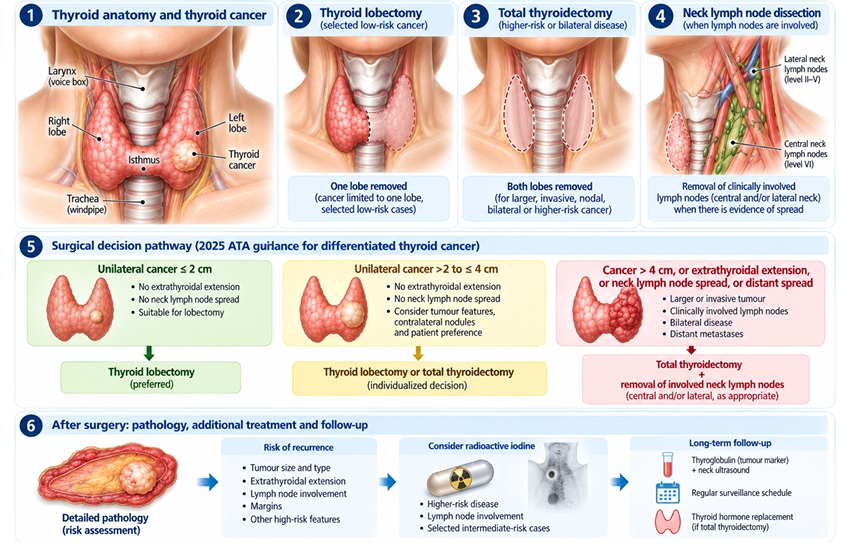
When is thyroid lobectomy appropriate?
Under the 2025 ATA guidance, a differentiated cancer limited to one thyroid lobe and measuring 2 cm or less, with no
extension outside the thyroid and no clinical neck lymph-node spread, should generally be treated with lobectomy. This
removes the affected lobe while leaving the opposite lobe in place.
What about a cancer between 2 and 4 cm?
For a unilateral cancer larger than 2 cm and up to 4 cm without extrathyroidal extension or clinical lymph-node spread,
either lobectomy or total thyroidectomy may be appropriate. Tumour characteristics, nodules in the opposite lobe, the
likelihood of needing radioactive iodine, follow-up strategy and patient preference all influence the decision.
When is total thyroidectomy recommended?
Total thyroidectomy is generally recommended for differentiated cancers larger than 4 cm, cancers extending outside
the thyroid, clinically significant lymph-node metastases, distant metastatic disease, and other situations in which the
disease pattern or treatment strategy requires removal of both lobes.
What are the advantages of lobectomy?
Lobectomy is a smaller operation. It avoids surgical risk to the recurrent laryngeal nerve and parathyroid glands on the
opposite side and may allow the remaining thyroid lobe to produce enough hormone that lifelong replacement is
unnecessary. It can provide excellent cancer control in properly selected low-risk patients.
What are the advantages of total thyroidectomy?
Total thyroidectomy treats disease involving both lobes and is appropriate for many higher-risk cancers. It facilitates
radioactive iodine treatment when indicated and allows thyroglobulin to be used more sensitively as a tumour marker
during follow-up. It does, however, require lifelong thyroid-hormone replacement.
Can I need a second operation after lobectomy?
Yes, but completion thyroidectomy is no longer considered routine simply because cancer is found after lobectomy.
Under the 2025 guidance, removal of the remaining lobe may be considered when persistent disease needs treatment,
radioactive iodine is planned, or follow-up would benefit from total thyroid removal. Final pathology is central to this
decision.
Are lymph nodes always removed?
No. The surgeon evaluates the central and lateral neck for nodal disease before surgery, usually with ultrasound.
Therapeutic lymph-node dissection is performed when nodes are clinically involved. Routine extensive removal of
normal-appearing lateral neck lymph nodes is not part of standard treatment.
What is a central neck dissection?
The central compartment contains lymph nodes immediately around the thyroid, trachea and recurrent laryngeal
nerves. When cancer has spread to these nodes, they can be removed systematically. This requires careful
preservation of the recurrent laryngeal nerves and parathyroid glands.
What is a lateral neck dissection?
When thyroid cancer has spread to lymph nodes along the side of the neck, the involved lymph-node compartments are
removed in a planned compartment-oriented dissection. This is different from removing one isolated enlarged node and
is designed to achieve durable regional disease control.
What are the main risks of thyroid-cancer surgery?
Important risks include postoperative neck bleeding, voice change from recurrent laryngeal nerve injury, and low
calcium from parathyroid dysfunction. Hypocalcaemia is principally a concern after total thyroidectomy and central neck
surgery. The extent of surgery therefore matters when balancing benefit and risk.
Will my voice change?
Temporary hoarseness can occur from the breathing tube, swelling or nerve irritation. The recurrent laryngeal nerves
run immediately behind the thyroid and control vocal-cord movement. Permanent nerve injury is uncommon but is an
important recognised complication.
Why can calcium fall after total thyroidectomy?
Four small parathyroid glands usually lie behind the thyroid and regulate blood calcium. During total thyroidectomy they
must be carefully preserved with their blood supply. Temporary reduced function can cause tingling or cramps and may
require calcium and vitamin D; permanent hypoparathyroidism is less common.
Will I need radioactive iodine?
Not every patient does. Radioactive iodine is used selectively according to recurrence risk, final pathology, lymph-node
involvement, residual disease and other features. Many low-risk patients treated adequately with surgery receive no
radioactive iodine.
Why is the final pathology so important?
Pathology confirms the exact cancer type, tumour size, margins, vascular invasion, extension beyond the thyroid and
lymph-node involvement. These findings refine the risk of recurrence and determine whether additional surgery,
radioactive iodine or simply surveillance is appropriate.
What happens after surgery?
After total thyroidectomy, thyroid-hormone replacement is lifelong. After lobectomy, thyroid function is checked because
some patients require replacement while others do not. Follow-up is tailored to risk and may include clinical
examination, neck ultrasound, thyroid-function tests and tumour markers such as thyroglobulin.
What is thyroglobulin?
Thyroglobulin is a protein produced by thyroid cells and many differentiated thyroid cancer cells. After total
thyroidectomy, especially when radioactive iodine has also been used, a rising or unexpected thyroglobulin level can
help identify persistent or recurrent disease. Interpretation after lobectomy is different because normal thyroid tissue
remains.
Can thyroid cancer come back?
Yes, although many differentiated thyroid cancers have a low recurrence risk. Recurrence can occur in the thyroid bed,
lymph nodes or less commonly distant organs. Risk-adapted surveillance aims to detect clinically important recurrence
while avoiding unnecessary testing in very-low-risk patients.
What is the outlook?
For most patients with localised differentiated thyroid cancer, prognosis is excellent. The objective of modern treatment
is therefore not only cancer control, but also avoiding unnecessary treatment and its long-term consequences.
More surgery is not automatically better cancer treatment. Modern thyroid-cancer surgery aims to perform
the least extensive operation that still provides appropriate oncological control for that individual cancer.
Frequently Asked Questions
If I have thyroid cancer, why not remove the whole thyroid to be safe?
For selected low-risk cancers, total thyroidectomy has not shown enough additional benefit to justify automatically
exposing the opposite recurrent laryngeal nerve and parathyroid glands to surgery. The operation should match the
cancer risk.
Can a 1 cm papillary cancer ever be watched instead of removed?
Yes. Active surveillance can be appropriate for carefully selected low-risk papillary microcarcinomas when reliable
expert follow-up is available.
If I have a lobectomy, will I definitely avoid thyroid tablets?
No. Many patients maintain normal thyroid function, but some develop hypothyroidism and require replacement.
Does lymph-node spread mean the cancer is incurable?
No. Papillary thyroid cancer commonly spreads to neck lymph nodes and can still have an excellent prognosis. Nodal
disease changes treatment and recurrence risk, but does not automatically imply a poor outcome.
Does everyone need radioactive iodine after total thyroidectomy?
No. It is now used selectively according to recurrence risk and pathology.
Will I need follow-up for life?
The intensity and duration of follow-up are individualised. Higher-risk disease requires closer surveillance, while
patients with an excellent response can often have follow-up reduced over time.
The key message
Thyroid-cancer treatment is increasingly personalised. For selected low-risk unilateral cancers, lobectomy can
provide appropriate cancer treatment while preserving half of the thyroid. Total thyroidectomy and lymph-node
surgery remain important for larger, invasive, nodal and higher-risk disease. Final pathology then guides
radioactive iodine and long-term surveillance.
This article is for general patient education and does not replace individual thyroid-cancer staging, multidisciplinary assessment or advice from your treating surgeon and endocrinologist.
Dr. Mohammed Alassaf
Consultant Bariatric & Gastrointestinal Surgeon
Dr. Alassaf is a leading expert in minimally invasive and bariatric surgery,
with extensive experience helping patients overcome obesity and related conditions.
Having completed advanced training in Australia and the Middle East, he is known
for his compassionate approach and evidence-based surgical care.