SCOLA Repair: Treating a Hernia and Rectus Diastasis Together
Rectus Diastasis, Ventral Hernia & SCOLA Repair
SCOLA Repair: Treating a Hernia and Rectus Diastasis Together
Dr-Alassaf
Nov 05, 2026
A small umbilical or epigastric hernia can sometimes be only part of the problem. In some patients, the
hernia occurs together with rectus diastasis - a widening and weakening of the tissue between the two
rectus abdominal muscles.
In this situation, repairing only the small hernia may leave the wider midline weakness untreated. SCOLA is
a minimally invasive technique designed to repair the hernia and reconstruct the associated rectus diastasis
during the same operation.
SCOLA is a specialized abdominal-wall technique and is not widely used in Jordan. Careful patient
selection is important because it is not the appropriate operation for every ventral hernia or every patient
with rectus diastasis.
What is rectus diastasis?
The two rectus muscles run vertically down the front of the abdomen. Between them is a strong band of
connective tissue called the linea alba.
In rectus diastasis, the linea alba becomes stretched and widened, allowing the rectus muscles to move
farther apart. This can create a long central bulge, particularly when sitting up, coughing or exercising.
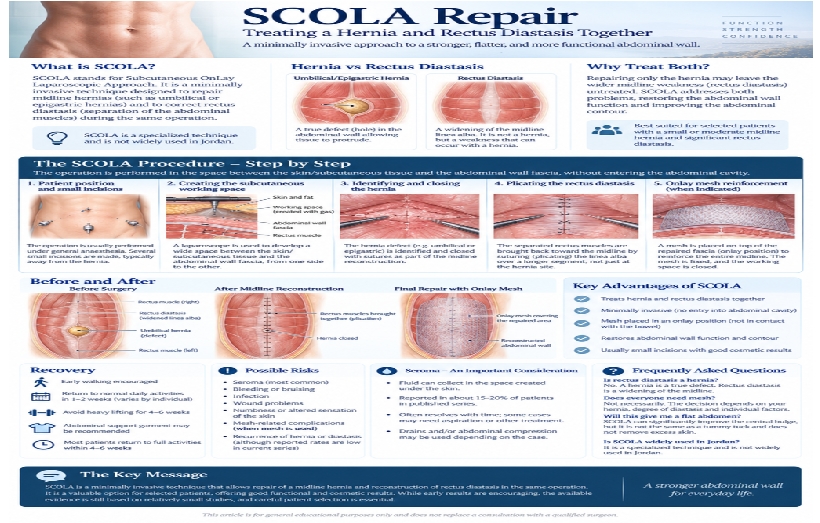
Rectus diastasis is not itself a hernia. A hernia is a true defect or hole in the abdominal wall. However, an
umbilical or epigastric hernia can occur within a widened and weakened linea alba, so both conditions may
be present together.
Why treat the hernia and the diastasis together?
Imagine a small hole in the middle of a long, stretched piece of fabric. Closing only the hole fixes the
obvious defect, but it does not reconstruct the weakened material surrounding it.
The same principle can apply when a small midline hernia occurs within significant rectus diastasis. SCOLA
allows the surgeon to close the actual hernia while also bringing the separated rectus muscles back toward
the midline over a longer segment of the abdominal wall.
What does SCOLA mean?
SCOLA stands for Subcutaneous OnLay Laparoscopic Approach. The operation is performed in a
working space created underneath the skin and subcutaneous fat but above the abdominal-wall fascia.
This is different from conventional laparoscopy performed mainly inside the abdominal cavity. The surgeon
uses a camera and long instruments through small incisions to expose and reconstruct the front of the
abdominal wall.
How is the SCOLA operation performed?
Although the exact technique is adapted to the patient's anatomy, the operation can be understood in
several main stages.
1. Creating the working space. Small incisions are made and a space is carefully developed between the
subcutaneous tissue and the abdominal-wall fascia. This allows the surgeon to work along the midline
using minimally invasive instruments.
2. Exposing the midline. The linea alba, the borders of the rectus muscles and the hernia are exposed
over the length required for reconstruction.
3. Repairing the hernia. The hernia contents are reduced and the true fascial defect - commonly an
umbilical or epigastric defect - is closed.
4. Correcting the rectus diastasis. Sutures are placed along the widened midline to plicate the linea alba
and bring the rectus muscles back toward one another. This reconstruction extends beyond the small
hernia itself.
5. Reinforcing the repair. When mesh reinforcement is indicated, a broad mesh is positioned in an onlay
position over the reconstructed fascia. The mesh therefore reinforces the repaired abdominal wall without
being placed inside the abdominal cavity.
Why is the mesh position important?
In SCOLA, mesh reinforcement - when used - is placed on top of the abdominal-wall fascia. It is not
positioned freely inside the abdominal cavity against the bowel.
The aim of the mesh is to reinforce the longer reconstructed midline rather than simply cover the small
visible hernia opening.
Who may be suitable for SCOLA?
SCOLA can be particularly useful for selected patients who have a small or moderate umbilical or
epigastric hernia together with significant rectus diastasis.
A typical patient may notice both a localized hernia around the umbilicus and a longer central ridge or bulge
when contracting the abdominal muscles.
Very large or complex hernias, extensive previous abdominal-wall surgery, marked skin excess, significant
obesity or other anatomical factors may require a different type of abdominal-wall reconstruction.
Is SCOLA a cosmetic operation?
No. The primary purpose is to repair the hernia and reconstruct the weakened abdominal midline. Restoring
the rectus muscles toward the midline can also improve abdominal contour, but SCOLA is not the same as
an abdominoplasty or tummy tuck.
It does not remove a large amount of loose skin, and it should not be expected to produce the same result
as a plastic-surgery procedure designed primarily to address skin excess.
What is a seroma, and why is it important?
Seroma is one of the characteristic postoperative issues after SCOLA. Because the operation creates a
relatively broad space underneath the skin and fatty tissue, clear fluid can collect within that space during
healing.
A seroma does not automatically mean that the repair has failed or become infected. Many collections
gradually resolve, while some may require aspiration or other treatment. Depending on the repair and the
surgeon's protocol, drains and/or an abdominal compression garment may be used.
What are the other possible risks?
Possible complications include bleeding, bruising, infection, wound problems, temporary numbness or
altered skin sensation, discomfort, seroma, mesh-related problems when mesh is used, recurrence of the
hernia and recurrence or persistence of the rectus diastasis.
No abdominal-wall reconstruction can guarantee that a hernia or diastasis will never recur. The patient's
tissues, weight, activity, previous surgery and the anatomy of the original problem all influence long-term
results.
What happens after surgery?
Walking is encouraged early after the operation. Because the reconstruction may extend over a
considerably larger area than the original small hernia, patients often experience tightness and discomfort
along the central abdomen during the early recovery period.
Normal daily activity is gradually increased, while heavy lifting and strenuous abdominal exercise are
restricted during initial healing. Some patients may be advised to wear an abdominal support garment for a
period after surgery.
Frequently Asked Questions
Is rectus diastasis the same as a hernia?
No. A hernia is a true defect in the abdominal wall. Rectus diastasis is a widening of the linea alba between
the rectus muscles. The two can occur together.
Why not simply repair my umbilical hernia?
If there is substantial rectus diastasis, the small hernia may lie within a much broader area of weakened
midline tissue. SCOLA is designed to reconstruct that wider area as well as close the hernia itself.
Does SCOLA enter the abdominal cavity?
The main working space is created above the abdominal-wall fascia and beneath the subcutaneous tissue.
The operation is therefore fundamentally different from a conventional intraperitoneal laparoscopic
ventral-hernia repair.
Does everyone need mesh?
Not necessarily. Mesh use depends on the hernia, the extent of the diastasis, tissue quality and the
surgeon's operative plan. When mesh is used in SCOLA, it is generally placed in an onlay position over the
reconstructed fascia.
Will SCOLA make my abdomen completely flat?
That cannot be guaranteed. Reconstructing the midline can substantially improve a central bulge, but
abdominal contour is also affected by skin, subcutaneous fat, muscle tone and individual anatomy.
Is SCOLA commonly performed in Jordan?
No. SCOLA remains a specialized technique and is not widely used in Jordan.
The key message
SCOLA treats the abdominal wall as a whole rather than concentrating only on a small visible hernia
defect.
In selected patients with a midline hernia and significant rectus diastasis, the operation allows the surgeon
to close the hernia, reconstruct the widened linea alba and, when appropriate, reinforce the repair
with an onlay mesh through a minimally invasive approach.
The most important factor is appropriate patient selection. SCOLA is not required for every small hernia and
is not a substitute for abdominoplasty when excess skin is the main problem. Its role is to provide a
functional reconstruction of the hernia and weakened abdominal midline together.
Dr. Mohammed Alassaf
Consultant Bariatric & Gastrointestinal Surgeon
Dr. Alassaf is a leading expert in minimally invasive and bariatric surgery,
with extensive experience helping patients overcome obesity and related conditions.
Having completed advanced training in Australia and the Middle East, he is known
for his compassionate approach and evidence-based surgical care.