Inguinal Hernia Surgery: Understanding TEP and TAPP Repair
Inguinal Hernia & Laparoscopic Hernia Repair
Inguinal Hernia Surgery: Understanding TEP and TAPP Repair
Dr-Alassaf
Nov 04, 2026
An inguinal hernia occurs when tissue from inside the abdomen pushes through a weak area in the groin. It may appear as a lump that becomes more noticeable when standing, coughing or straining, and it can cause discomfort or pain.
When an inguinal hernia needs repair, there are several established surgical techniques. In suitable patients, I generally favour a laparoscopic TEP repair. TAPP is another effective minimally invasive approach and can be useful when the individual anatomy or operative circumstances make it more appropriate.
What is an inguinal hernia?
The groin contains natural openings through which important structures pass. An inguinal hernia develops when abdominal tissue protrudes through a weakness in this region.
Some hernias remain relatively painless, while others gradually enlarge or interfere with exercise, work and everyday activity. A hernia does not heal by itself. Whether it should be repaired depends on symptoms, the type of hernia, the patient's health and the risk of future problems.
When is surgery needed?
Surgery is commonly recommended for symptomatic inguinal hernias. In some men with a minimally symptomatic hernia, careful observation can be reasonable after discussion with the surgeon.
A hernia that suddenly becomes very painful, cannot be pushed back, or is associated with vomiting or abdominal distension requires urgent medical assessment because the contents of the hernia may have become trapped.
Why is mesh used?
Modern inguinal hernia repair usually reinforces the weak area with a flat surgical mesh. The mesh covers the potential hernia sites in the groin and allows the patient's own tissues to grow into and support the repair.
International hernia guidelines recommend mesh-based repair for the majority of patients because it reduces recurrence compared with non-mesh repair.
What is laparoscopic TEP repair?
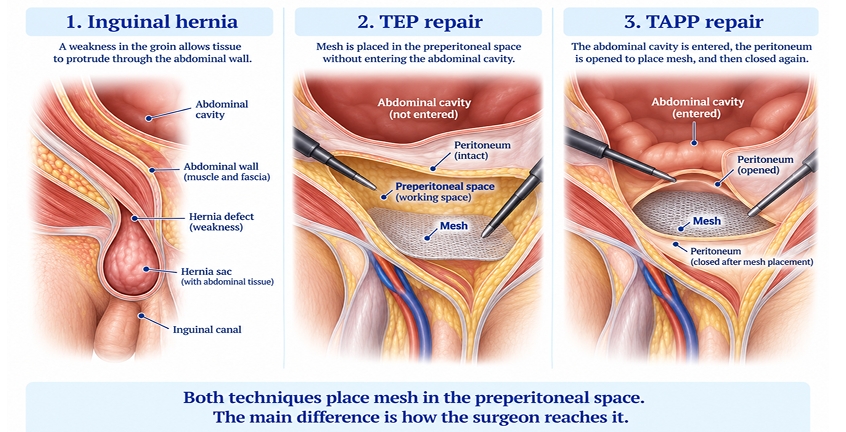
TEP stands for totally extraperitoneal repair. The surgeon creates a working space between the abdominal wall and the lining of the abdominal cavity, called the peritoneum.
The hernia is reduced and a broad piece of mesh is placed in this preperitoneal space to cover the weak areas of the groin. The abdominal cavity itself is not deliberately entered.
This is the laparoscopic technique I generally prefer when it is appropriate for the patient. One reason is that the repair can be completed in the correct preperitoneal plane without routinely entering the abdominal cavity.
TEP and TAPP: what is the difference?
Both TEP and TAPP are minimally invasive posterior mesh repairs. Importantly, the mesh ultimately sits in essentially the same preperitoneal position. The main difference is how the surgeon reaches that space.
What is TAPP repair?
TAPP stands for transabdominal preperitoneal repair. The surgeon first enters the abdominal cavity.
The peritoneum is then opened in the groin, the hernia is reduced, and mesh is positioned in the preperitoneal space. The peritoneum is closed over the mesh at the end of the repair.
TAPP provides an excellent view from inside the abdomen and can be particularly useful when inspection of the abdominal cavity is helpful or when the anatomy or circumstances make a TEP approach less suitable.
Is TEP better than TAPP?
I generally prefer TEP when it is technically appropriate because it avoids routine entry into the abdominal cavity and avoids opening and closing the peritoneum.
That preference should not be interpreted to mean that TAPP is an inferior operation. Published evidence and international guidelines regard both TEP and TAPP as established laparo-endoscopic approaches, with broadly comparable outcomes when performed by experienced surgeons. The choice should take account of the patient, the hernia and the surgeon's expertise.
What about bilateral or recurrent hernias?
A minimally invasive posterior approach is particularly useful when hernias are present on both sides because both groins can be addressed through the same small incisions.
It is also frequently useful for a recurrent hernia after a previous open anterior repair because the surgeon approaches the groin through a different tissue plane.
What happens after surgery?
Most patients are encouraged to walk soon after the operation and can usually return home the same day or after a short stay, depending on their circumstances.
Bruising, swelling and a feeling of tightness or pulling in the groin are common early in recovery. Men may also notice temporary swelling or bruising around the scrotum.
Activity is increased gradually. Walking and normal light activities are encouraged, while return to strenuous exercise and heavy lifting depends on comfort, the nature of the repair and the surgeon's postoperative advice.
What are the possible risks?
Inguinal hernia repair is commonly performed and is generally safe, but complications can occur. These include bleeding, infection, seroma or fluid collection, urinary retention, bruising, recurrence and persistent groin discomfort or chronic pain.
Laparoscopic repair also carries uncommon risks related to nearby blood vessels, nerves, the bladder, bowel and other abdominal structures. The exact risk varies with the type of hernia, previous surgery and individual anatomy.
Can the hernia come back?
Yes. No hernia repair has a zero recurrence rate. Careful dissection, adequate mesh coverage and correct mesh positioning are important technical factors in reducing recurrence.
If a new lump or persistent pain develops after recovery, it should be assessed rather than automatically assumed to represent recurrence.
Frequently Asked Questions
Does TEP mean there is no mesh?
No. TEP is a mesh repair. The name describes the route used to reach the preperitoneal space, not whether mesh is used.
Does TEP enter the abdominal cavity?
The intention in TEP is to create and work within the preperitoneal space without deliberately entering the abdominal cavity. Small openings in the peritoneum can occasionally occur during dissection and are managed during the operation.
Is TAPP an open operation?
No. TAPP is also a laparoscopic or robotic minimally invasive operation. The difference is that the surgeon enters the abdominal cavity before accessing the preperitoneal space.
Why might you use TAPP instead of TEP?
TAPP can be useful when the anatomy, previous surgery, complexity of the hernia or findings during the operation make a transabdominal view advantageous. The approach is selected to allow the repair to be completed safely and effectively.
Can both groins be repaired at the same operation?
Yes. Bilateral inguinal hernias can often be repaired during the same minimally invasive operation.
The key message
TEP and TAPP are two minimally invasive ways of placing mesh behind the groin to reinforce an inguinal hernia repair.
In my practice, I generally favour TEP when appropriate because the repair is performed in the preperitoneal space without routinely entering the abdominal cavity. TAPP remains an important alternative and is used when it offers an advantage for the individual patient or operative situation.
The objective is not simply to choose a particular acronym. It is to achieve a safe, durable repair with good mesh coverage, a low risk of recurrence and a comfortable recovery.
Dr. Mohammed Alassaf
Consultant Bariatric & Gastrointestinal Surgeon
Dr. Alassaf is a leading expert in minimally invasive and bariatric surgery,
with extensive experience helping patients overcome obesity and related conditions.
Having completed advanced training in Australia and the Middle East, he is known
for his compassionate approach and evidence-based surgical care.