Large and Complex Colon Polyps: Endoscopy or Surgery?
Colon Polyps & Colorectal Cancer Prevention
Large and Complex Colon Polyps: Endoscopy or Surgery?
Dr-Alassaf
Nov 02, 2026
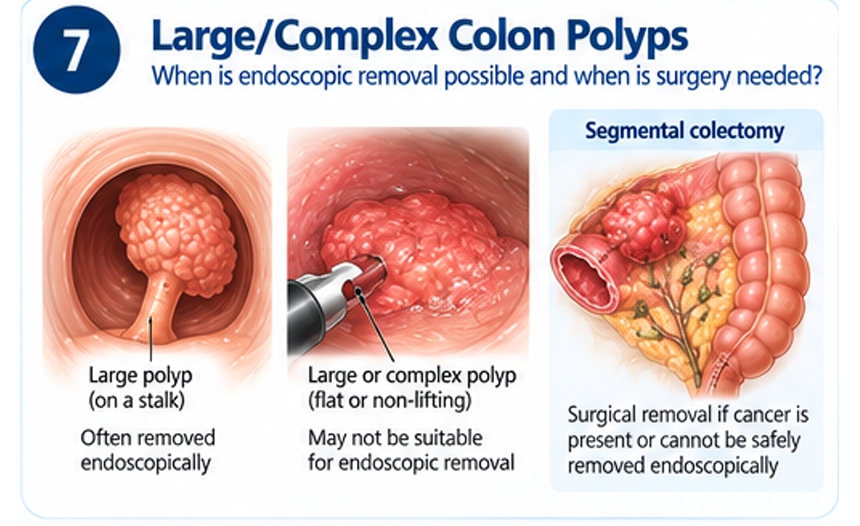
Most colorectal polyps can be removed during colonoscopy and never require an abdominal operation. The challenge is deciding which large or complex lesions can still be removed safely by advanced endoscopy and which require formal bowel resection because cancer is present or cannot be excluded adequately.
What makes a polyp 'complex'?
Features include large size, a flat or laterally spreading shape, difficult location, previous incomplete removal, scarring, non-lifting, involvement of a fold or valve, and endoscopic features suspicious for deep cancer invasion.
Does a large polyp automatically require colectomy?
No. Size alone should not determine surgery. Advanced techniques such as endoscopic mucosal resection and endoscopic submucosal dissection can remove many lesions that would previously have been referred directly for bowel surgery.
Why is expert endoscopic assessment important?
A lesion that looks difficult during routine colonoscopy may still be removable by an advanced endoscopist. Referral before repeated biopsy or attempted piecemeal removal can preserve treatment options and sometimes avoid unnecessary colectomy.
When is surgery the better option?
Formal resection is appropriate when invasive cancer has features associated with lymph-node spread, when deep invasion is strongly suspected, when complete endoscopic removal is not technically safe or feasible, or when endoscopic pathology indicates inadequate cancer treatment.
Why does lymph-node risk matter?
Endoscopic removal treats the lesion in the bowel wall but does not remove regional lymph nodes. If an invasive cancer has meaningful risk of nodal disease, segmental oncological colectomy is recommended to treat and stage those nodes.
What is a malignant polyp?
A malignant polyp contains invasive adenocarcinoma that has passed through the muscularis mucosae into the submucosa. Some low-risk malignant polyps are adequately treated by complete endoscopic excision; others require bowel resection.
What features may lead to surgery after endoscopic removal?
Examples include an involved or inadequate margin, poor differentiation, lymphovascular invasion, deep submucosal invasion or other adverse pathological features. Decisions should be made in a colorectal multidisciplinary setting.
What operation is performed if surgery is needed?
The segment of colon containing the lesion is removed together with its blood supply, mesentery and regional lymph nodes, just as for a colon cancer operation. Bowel continuity is usually restored with an anastomosis.
Does biopsy always tell us whether the entire polyp is benign?
No. A small biopsy samples only part of a large lesion and can miss a focus of invasive cancer. The lesion's endoscopic appearance and complete excision specimen are often more informative.
Why not simply remove every difficult polyp surgically?
Colectomy is a major operation with risks such as leak, infection, ileus and hernia. When a benign lesion can be completely and safely removed endoscopically, avoiding bowel resection can offer a major benefit.
Frequently Asked Questions
Should I ask for an advanced endoscopy opinion before surgery?
For a complex lesion believed to be benign or superficially invasive, expert endoscopic review is often valuable.
Can a polyp come back after endoscopic removal?
Residual or recurrent tissue can occur, especially after piecemeal resection, which is why structured endoscopic surveillance is important.
If cancer is found after polyp removal, do I definitely need colectomy?
Not always. The pathology determines whether endoscopic treatment is considered oncologically adequate.
The key message
The important question is not whether a polyp is large, but whether it can be completely and safely removed endoscopically and whether invasive cancer creates a lymph-node risk that requires formal colectomy.
This article is for general patient education and does not replace individual assessment, cancer staging, multidisciplinary review or advice from your treating surgical team.
Dr. Mohammed Alassaf
Consultant Bariatric & Gastrointestinal Surgeon
Dr. Alassaf is a leading expert in minimally invasive and bariatric surgery,
with extensive experience helping patients overcome obesity and related conditions.
Having completed advanced training in Australia and the Middle East, he is known
for his compassionate approach and evidence-based surgical care.