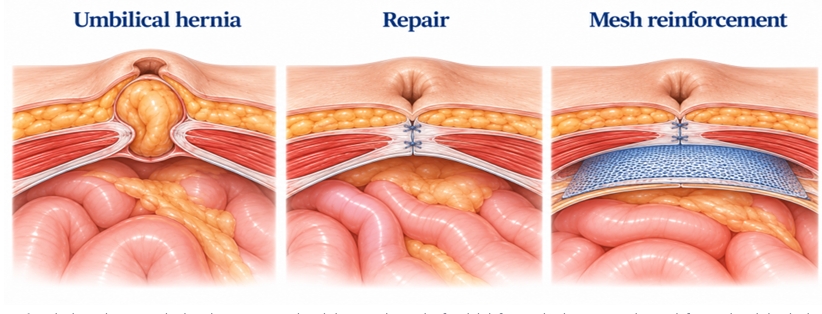
An umbilical hernia is a weakness or opening in the abdominal wall at the belly button. Fat, and occasionally
bowel, can push through this opening and create a lump.
In adults, an umbilical hernia does not usually heal by itself. However, having an umbilical hernia does not
automatically mean that you need an operation immediately. The decision depends on its size,
symptoms, whether it is changing, your general health and the anatomy of the surrounding abdominal wall.
Why do adults develop umbilical hernias?
The umbilicus is a naturally weaker area of the abdominal wall. Over time, repeated pressure can stretch this
area and allow a defect to develop.
Factors associated with umbilical hernias include weight gain or obesity, pregnancy, ageing, repeated heavy
straining, chronic cough and conditions that increase pressure inside the abdomen. Some patients also have
rectus diastasis - a wider thinning of the midline between the rectus muscles.
What symptoms can an umbilical hernia cause?
Some patients notice only a soft lump at the belly button. It may become more obvious when standing,
coughing or straining and become smaller when lying down.
Others develop discomfort, pressure or pain, particularly with exercise or lifting. A hernia may also gradually.
When should I seek urgent medical attention?
Most umbilical hernias are not emergencies. However, a hernia that becomes suddenly very painful, firm,
irreducible or associated with vomiting or abdominal distension requires urgent assessment. These
symptoms can indicate that tissue has become trapped or that its blood supply is threatened.
Does every umbilical hernia need surgery?
No. A small, reducible hernia that causes little or no trouble may sometimes be observed, particularly when
the risks of surgery outweigh the expected benefit.
Surgery is more commonly discussed when the hernia is painful, enlarging, difficult to reduce, interfering with
activity or causing significant concern. Patient preference also matters.
Observation does not make the defect disappear, so patients choosing this approach should understand what
changes or symptoms should prompt reassessment.
How is an umbilical hernia repaired?
The basic principles are straightforward: the hernia contents are returned to their normal position and the
opening in the abdominal wall is repaired.
The operation may be performed through a small open incision around the umbilicus or, for selected larger
defects or patients with particular wound-risk considerations, by a minimally invasive approach. The choice
depends on the hernia and the patient.
Do I need mesh?
This is one of the most common questions. Mesh is used to reinforce the repair and reduce the chance of the
hernia returning. International EHS/AHS guidance recommends mesh for most adult umbilical and epigastric
hernia repairs because it reduces recurrence.
For very small defects below 1 cm, the evidence is less certain and a suture-only repair can be considered
after discussion with the patient. For defects of approximately 1-4 cm, current guidance generally favours
mesh reinforcement.
The decision is not based on diameter alone. Tissue quality, obesity, previous recurrence, rectus diastasis,
infection risk and the overall abdominal-wall anatomy also matter.
Where is the mesh placed?
Mesh can be positioned in several anatomical layers. For a conventional open repair, guidelines generally
favour a flat mesh in the preperitoneal space - deep to the abdominal-wall fascia and outside the abdominal
cavity - when that approach is appropriate.
For larger or more complex repairs, other mesh positions and minimally invasive techniques may be
considered. The objective is to provide broad reinforcement while choosing a position suited to the individual
anatomy.
What if I also have rectus diastasis?
This is important because an umbilical hernia may sit within a much wider area of midline weakness. Rectus
diastasis is not itself a hernia, but it changes the mechanical environment around the defect.
For a patient with a small umbilical hernia and significant diastasis, simply closing the small hole may not
address the whole problem. In selected patients, the hernia and the diastasis can be reconstructed together.
Techniques such as SCOLA may be considered for suitable anatomy.
What are the risks of surgery?
Umbilical hernia repair is generally a common operation, but complications can occur. These include bleeding,
wound infection, fluid collection (seroma), temporary or persistent discomfort, recurrence and, less commonly,
mesh-related complications.
The individual risk depends on the size and complexity of the hernia as well as factors such as smoking,
obesity, diabetes and previous surgery.
What is recovery usually like?
Most patients are encouraged to walk soon after surgery. Discomfort is usually greatest during the first few
days and then improves progressively.
Return to driving, work and exercise depends on the size of the repair, the surgical approach and how the
patient feels. A small uncomplicated umbilical repair is very different from a large abdominal-wall
reconstruction, so postoperative advice should be individualized.
Frequently Asked Questions
Can an adult umbilical hernia heal without surgery?
The actual fascial defect generally does not close spontaneously in an adult. Symptoms may remain stable,
however, and selected minimally symptomatic hernias can sometimes be observed.
If my hernia does not hurt, can I leave it alone?
Possibly. Symptoms, size, reducibility, progression and your general health all influence the decision.
Observation should include an understanding of the warning symptoms that require reassessment.
Is mesh always necessary?
No. Mesh is recommended for most repairs because it lowers recurrence, but suture repair can be considered
for selected very small defects, particularly those below 1 cm. The choice should be individualized.
Will I feel the mesh?
Usually not after healing. Mesh becomes incorporated into the surrounding tissue. Some patients notice
firmness or awareness early after surgery, which commonly settles as healing progresses.
Can the hernia come back after surgery?
Yes. No repair has a zero recurrence rate. Mesh reinforcement reduces recurrence compared with suture
repair in many adult umbilical hernias, but patient factors, tissue quality and technique also influence long-term
durability.
Is an umbilical hernia the same as rectus diastasis?
No. An umbilical hernia is a true hole in the fascia. Rectus diastasis is widening and thinning of the midline
without a true defect. They can, however, occur together.
The key message
An adult umbilical hernia does not automatically require immediate surgery, but it also does not
usually disappear by itself.
The decision to operate should consider symptoms, size, progression, patient health and the condition of the
surrounding abdominal wall. When repair is appropriate, mesh reinforcement is commonly used because it
reduces recurrence, while selected very small defects may still be suitable for suture repair.
If rectus diastasis is present as well, the best operation may need to address more than just the small visible
hole at the umbilicus.
This article is for general educational purposes and does not replace an individualized consultation with a qualified surgeon.
Dr. Mohammed Alassaf
Consultant Bariatric & Gastrointestinal Surgeon
Dr. Alassaf is a leading expert in minimally invasive and bariatric surgery,
with extensive experience helping patients overcome obesity and related conditions.
Having completed advanced training in Australia and the Middle East, he is known
for his compassionate approach and evidence-based surgical care.