Ventral and Incisional Hernia Repair: Laparoscopic or Open Surgery?
Ventral & Incisional Hernias and Surgical Repair
Ventral and Incisional Hernia Repair: Laparoscopic or Open Surgery?
Dr-Alassaf
Nov 05, 2026
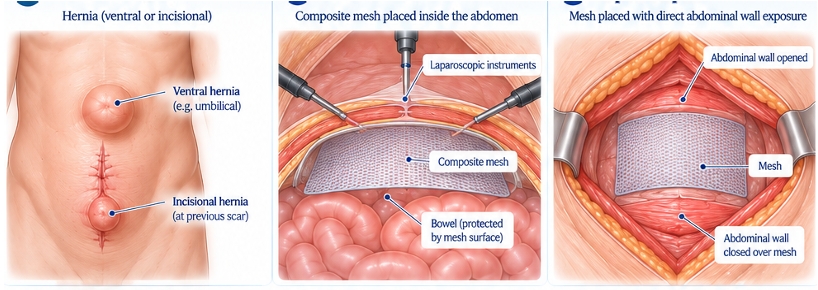
A ventral hernia is a weakness or opening in the abdominal wall. When a hernia develops through the scar
of a previous operation, it is called an incisional hernia.
Some hernias are small and straightforward. Others are larger, recurrent or occur after several previous
operations. The operation therefore needs to be tailored to the individual patient.
I repair ventral and incisional hernias using either a laparoscopic or an open approach. The choice
depends mainly on the size and position of the hernia, previous surgery and the condition of the abdominal
wall.
Why does a hernia develop?
The abdominal wall normally keeps the abdominal organs contained while allowing movement and
breathing. A hernia develops when part of this wall becomes weak and tissue pushes outward through the
defect.
Incisional hernias occur because a previous surgical scar can remain weaker than the surrounding
abdominal wall. The bulge may gradually enlarge and can cause discomfort, pain or difficulty with activity.
When is surgery considered?
Not every ventral hernia requires immediate surgery. Repair is usually considered when the hernia causes
symptoms, becomes larger, interferes with daily activity or has a significant risk of trapping its contents.
Sudden severe pain, vomiting, abdominal swelling or a hernia that becomes firm and cannot be pushed
back requires urgent medical assessment.
Why do we use mesh?
Closing a hernia means more than simply returning the bulge to the abdomen. The weakened abdominal
wall needs to be reinforced.
Mesh spreads the strength of the repair over a wider area. This is especially useful in incisional
hernias, where the tissue around the original scar may also be weak.
How is the hernia repaired?
There are two main approaches. Both aim to return the hernia contents to the abdomen, repair the
abdominal-wall defect and reinforce the repair with mesh when appropriate
Laparoscopic repair
During laparoscopic surgery, a camera and instruments are introduced through several small incisions
away from the hernia.
The hernia contents are returned to the abdomen and adhesions are released when necessary. When
possible, the actual defect in the abdominal wall is closed with sutures.
A composite mesh is then positioned with a wide overlap around the repair and secured to the abdominal
wall.
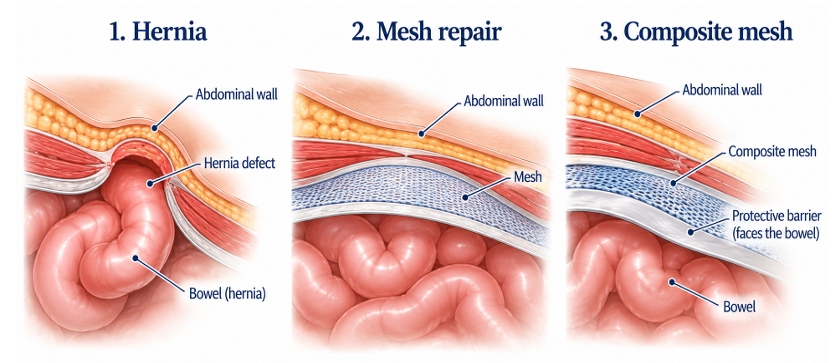
Why do I use composite mesh?
In laparoscopic repair, the mesh may be placed inside the abdominal cavity, close to the bowel.
Composite mesh is specifically designed for this position. One surface allows the mesh to integrate with
the abdominal wall, while the surface facing the abdominal organs has a protective barrier designed to
reduce tissue attachment.
This does not remove every possible mesh-related risk, but it allows a mesh designed for intraperitoneal
placement to be used when that position is appropriate.
Open repair
In an open repair, the hernia is approached directly through an incision. The hernia is reduced, the
abdominal wall is reconstructed and mesh is used when appropriate to reinforce the repair.
Open surgery may be preferable for large or complex hernias, recurrent hernias, patients with several
previous operations, significant scar tissue, or cases requiring a more extensive abdominal-wall
reconstruction.
An open operation is not necessarily a less advanced repair. For some hernias it provides the best access
to reconstruct the abdominal wall properly.
Laparoscopic or open - how do we choose?
The choice is based on the individual hernia rather than on a single preferred operation.
A smaller or moderately sized hernia may be well suited to laparoscopic repair. A large, complex or
recurrent incisional hernia may be better treated through an open approach. Previous operations and the
amount of scar tissue inside the abdomen are also important.
What is a seroma?
After the hernia is repaired, fluid can collect in the space where the hernia used to be. This is called a
seroma.
A seroma does not automatically mean that the hernia has returned. Many disappear gradually as the body
heals. Larger or persistent collections occasionally need further assessment or drainage.
What are the possible risks?
Possible complications include bleeding, infection, seroma, injury to bowel or nearby structures,
mesh-related problems, persistent discomfort and recurrence of the hernia.
The risk varies considerably between patients. Repairing a small first-time ventral hernia is very different
from reconstructing a large recurrent incisional hernia after several previous operations.
What happens after surgery?
Walking is encouraged early. Some patients undergoing smaller laparoscopic repairs can leave hospital
quickly, while larger open reconstructions may require a longer stay.
Activity is gradually increased as discomfort improves. Heavy lifting and strenuous abdominal exercise are
restricted during the initial healing period. The exact timing depends on the size and type of repair.
Frequently Asked Questions
Is laparoscopic surgery always better?
No. It is an excellent option for selected hernias, but some larger or more complex hernias are better
repaired through an open approach.
Is the mesh placed next to the bowel?
In some laparoscopic repairs, yes. When mesh is placed inside the abdominal cavity, I use a composite
mesh designed for intraperitoneal use, with a protective surface facing the abdominal organs.
Do you close the hernia defect?
When it is technically appropriate, I prefer to reconstruct and close the fascial defect rather than simply
bridge the opening with mesh. The exact technique depends on the individual hernia.
Can the hernia come back?
Yes. No hernia operation can guarantee zero recurrence. Hernia size, tissue quality, previous repairs,
weight, smoking and other factors can affect long-term results.
The key message
Ventral and incisional hernias need an individualized repair.
For suitable hernias, laparoscopic surgery allows repair through small incisions, with a composite mesh
designed for placement inside the abdomen. For larger or more complex hernias, an open operation
may provide better access for abdominal-wall reconstruction.
The objective is the same whichever approach is used: close and reinforce the weak area, restore the
abdominal wall and provide a durable repair with the lowest reasonable risk of recurrence.
This article is for general educational purposes and does not replace an individualized consultation with a qualified surgeon
Dr. Mohammed Alassaf
Consultant Bariatric & Gastrointestinal Surgeon
Dr. Alassaf is a leading expert in minimally invasive and bariatric surgery,
with extensive experience helping patients overcome obesity and related conditions.
Having completed advanced training in Australia and the Middle East, he is known
for his compassionate approach and evidence-based surgical care.